Web3 & AI

SOLUTIONS

Products

Services

Web3 & AI

SOLUTIONS

Services

Products

Industries

Become Our Client

About Us

Resources

Web3 & AI

SOLUTIONS

Services

Products

Industries

10 Best AI SEO Tools in 2026 (Tested with Pricing)

10 Best AI SEO Tools in 2026 (Tested with Pricing)

TL;DR
We checked the published pricing and documentation of ten AI SEO tools in 2026. The category now covers three separate jobs, and no single tool covers all three. TMX Visibility covers both content optimization and article-level AI visibility tracking. Surfer SEO, Clearscope, Frase, and NEURONwriter focus primarily on content optimization, while Otterly, Profound, and Writesonic specialize in AI citation tracking. Entry prices run from free to $139 a month. The right choice depends on which job the existing stack leaves unfilled.

Our Top Pick

TMX Visibility stands out as our top pick for content optimization and AI visibility tracking. It gives every draft a 0 to 100 Visibility Score before publication, so a team knows whether an article is strong enough to compete before it goes live. After publishing, it connects AI citations back to GA4 revenue rather than traffic alone, which is what turns content reporting into a business case. This tool is ideal for teams focused on outranking competitors in AI answers and proving content ROI.

Disclosure: TMX Visibility is developed by TokenMinds. We have identified it as the top option for draft optimization and GA4-linked AI performance tracking, based on the four criteria in the methodology section.

Why AI SEO Tools Matter in 2026

Google now answers many questions directly on the search results page. It allows users to read the answers without clicking through to a link. Publishers were the first to feel the impact. A Chartbeat study reported by Axios found that over two years, small publishers lost 60% of search traffic, medium-sized publishers lost 47%, and large publishers lost 22%.

Google acknowledged this issue. Google has explored various ways to integrate publisher content, including displaying links from publications to which readers were already subscribed in certain contexts. While various AI SEO tools on the market offer solutions to this problem, many teams end up purchasing the wrong ones.

For instance, a team already using Surfer purchases Clearscope, resulting in two tools evaluating the same draft, and neither tool can detect whether ChatGPT mentions their brand. Ultimately, the key question is not which tool is best, but rather what work remains unaddressed.

What Are the Best AI SEO Tools in 2026?

The best AI SEO tool depends on which of the three jobs a team needs filled. For optimizing content before it publishes, TMX Visibility scores drafts against ten named axes on a free plan. For keyword and rank research with AI search included, Semrush is the only tool here that combines both in a single subscription. For tracking brand visibility inside AI answers, Otterly covers four engines from $29 a month.

Every AI marketing tool below publishes its pricing, while three well-known tools do not, and those three were excluded for that reason. Below is an overview of the ten tools, covering the job each one performs, where its pricing starts, and the situation it suits best:

Tool

Job

Starts at

Best for

TMX Visibility

Content optimization and AI visibility

Free

AI visibility scoring before publish

Surfer SEO

Content optimization

$49

SERP-driven on-page editing

Clearscope

Content optimization

$129

Term coverage grading

Frase

Briefs and workflow

$49

Fast brief-to-draft production

NEURONwriter

Content optimization

$23

Optimizing on a tight budget

Semrush

Research and AI search

$139

One subscription for both jobs

Ahrefs

Research and backlinks

$29

Link and rank data

Otterly.ai

AI visibility

$29

Widest engine coverage, lowest entry

Profound

AI visibility

$99

Enterprise prompt analysis

Writesonic

AI visibility and content

$95

Tracking and content in one place

What an AI SEO Tool Does That a Traditional SEO Tool Does Not

The label now covers three jobs that used to be one. So before paying for any tool, a team needs to know which of those jobs it actually does.

  • Keyword and rank research is the traditional job, where the tool finds terms, estimates volume, and reports position in Google. Semrush and Ahrefs have owned this category for a decade, and nothing in the newer wave of products threatens them there.

  • Content optimization for extractability is the second job. Here the tool reads a draft and reports what a search engine or a language model would struggle to pull out of it, which covers entity coverage, term depth, structure, and source verifiability.

  • AI visibility tracking is the newest job. These tools run prompts against ChatGPT, Perplexity, Gemini, and others, then report whether a brand appears in the answers.

Job

What it reports

Tools that do it

What it does not solve

Research

Volume, difficulty, rank

Semrush, Ahrefs

Whether the page is extractable

Content optimization

Draft quality before publish

TMX, Surfer, Clearscope, Frase, NEURONwriter

Whether a model cites the brand

AI visibility

Brand presence in AI answers

TMX, Otterly, Profound, Writesonic

Which specific edits will change the outcome

How We Compared These 10 Tools

We checked every vendor's pricing page and published documentation in August 2026, and each tool is described by what its own materials state rather than by what its marketing summarises. Each tool was assessed against four criteria.

  • Jobs covered. How many of the three jobs the product performs.

  • Cost to reach the core capability. What a team pays before the main feature is usable.

  • Transparency. Whether pricing, engine coverage, and limits are published.

  • Prescriptive or descriptive. Whether the tool says what to change, or only reports a result.

All figures are monthly list prices rather than annual-discount rates, because annual framing makes a tool look cheaper than the first invoice does.

The 10 Best AI SEO Tools in 2026

1. TMX Visibility
1.png

Website

visibility.tmx.center

Pricing range

Free, Pro $199, and Business $499 

Best feature

  • Information gain to show how much new material the draft adds

  • Entity coverage to flag topics and names the draft is missing

  • Section-level scoring to mark which blocks need rewriting

  • Outrank scoring to compare the draft against competitor URLs

  • AI citation tracking to show where the article lands in AI answers

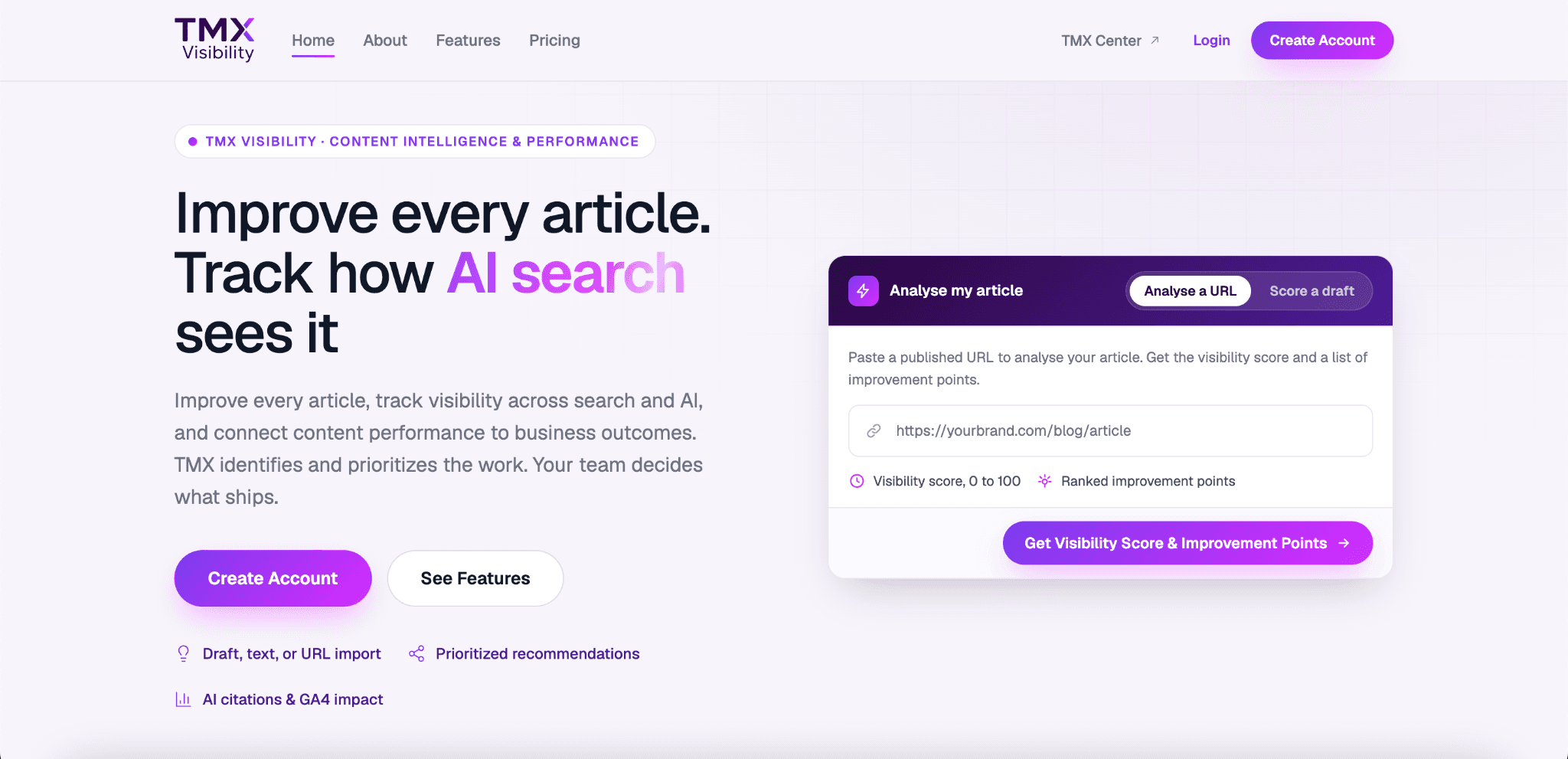
TMX Visibility helps writers optimize a draft so it can rank on Google and appear in AI answers. In our testing, we uploaded a draft on 'Web3 marketing strategies.' TMX Visibility flagged a missing entity 'decentralized autonomous organizations (DAOs)' and suggested adding a section on their role in Web3 governance. It also highlighted a paragraph on 'token utility' as having low information gain compared to top-ranking articles, prompting a rewrite to include more concrete examples. The tool then generated machine-readable JSON for the article, which helps search engines and AI models parse the page cleanly.

After publishing, the app tracks AI citations and average AI rank, then connects article performance to GA4 sessions, conversions, and revenue. This way an article is not just published, but optimized for AI and measured afterwards.

TMX Visibility's free plan offers essential article optimization scorers, including AI detection and source verifiability, making it accessible for testing workflows before budget commitments.

Disclosure: TMX Visibility is a TokenMinds product.

Pros

  • All article optimization scorers available on the free plan, including AI detection and source verifiability

  • Article performance tracking, with AI citations connected to GA4 sessions and conversions

  • JSON-LD schema generation on Pro

Cons

  • No keyword research, backlink analysis, or site crawling

  • Reports article-level visibility rather than per-engine share of voice

2. Surfer SEO
2.png

Website

surferseo.com 

Pricing range

$49 to $299. Enterprise $999

Best feature

  • Live content editor that regrades against currently ranking pages

  • AI prompt tracking, 25 to 100 prompts depending on tier

  • Mention gap, brand sentiment, and share of voice

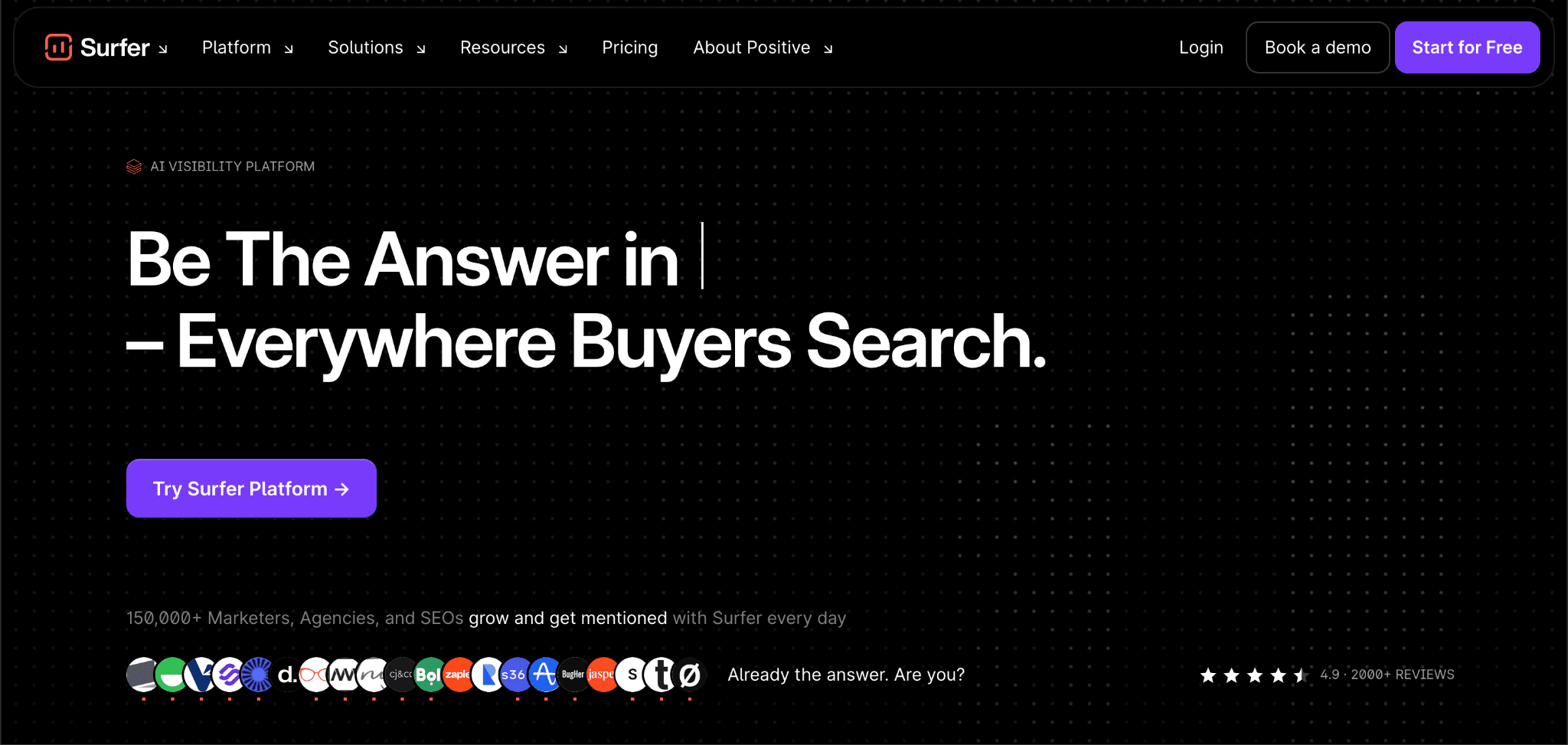
Surfer grades a draft against the pages currently ranking, then guides edits in a live editor. In our test, we used Surfer to optimize an article on 'B2B content marketing trends.' The tool recommended increasing the word count by 300 words and suggested adding terms like 'account-based marketing (ABM)' and 'thought leadership' based on top-ranking SERPs. Its term guidance is tied to a specific SERP rather than to general best practice, which is what separates it from cheaper optimizers. The AI tracking is where the tiers matter, because the plan most teams pick covers a single engine.

Pros

  • Content editor regrades a draft against currently ranking pages

  • AI Search Analytics sold standalone at $158 for tracking without the editor

  • Four published tiers between $49 and $299

Cons

  • The $99 Standard plan covers ChatGPT only, refreshed weekly

  • Multi-engine daily tracking starts at the $182 Pro tier

  • Enterprise pricing jumps to $999

3. Clearscope

3.png

Website

clearscope.io 

Pricing range

$129 to $399

Best feature

  • Term coverage reported as a single letter grade

  • Prompt tracking across ChatGPT and Gemini, 50 to 300 prompts

  • Query fan-out view showing the searches AI runs to build an answer

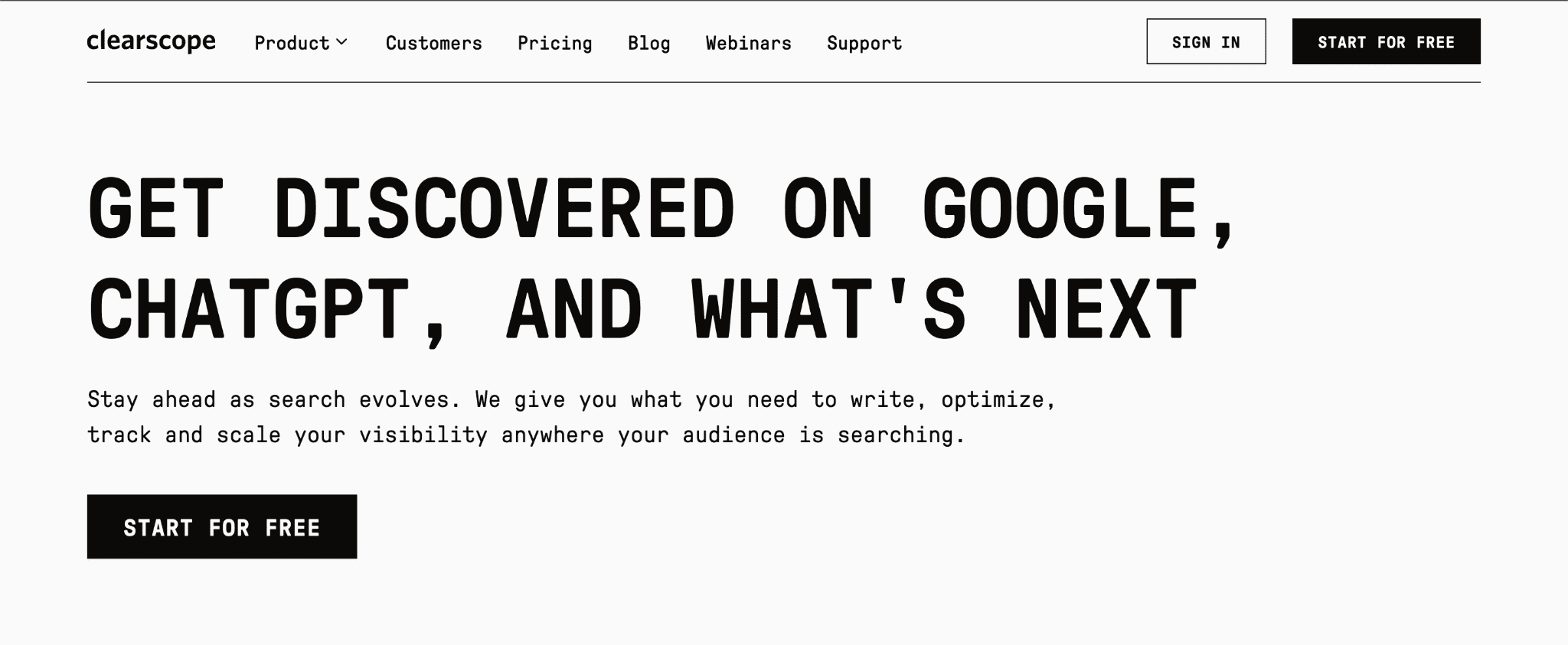
Clearscope grades content on how completely it covers the terms a topic requires. For instance, when we ran a draft about 'blockchain in supply chain' through Clearscope, it assigned a 'B+' grade and highlighted terms like 'smart contracts' and 'traceability' as underutilized. The report is designed to be actionable without SEO training, which suits teams briefing freelance writers. That simplicity comes at a price above tools that do more, and the product covers only one of the three jobs.

Pros

  • Term coverage reported as a single letter grade

  • Two published tiers with no enterprise gate below $399

  • Reports readable by writers with no SEO background

Cons

  • At $129, the entry plan costs more than Surfer, Frase, and NEURONwriter

  • AI engine coverage is not published anywhere public

  • No AI visibility tracking at either tier

4. Frase

4.png

Website

frase.io 

Pricing range

$49 to $299

Best feature

  • SERP research, brief, and draft in one workflow

  • Content optimization against currently ranking pages

  • AI writing built into the editor

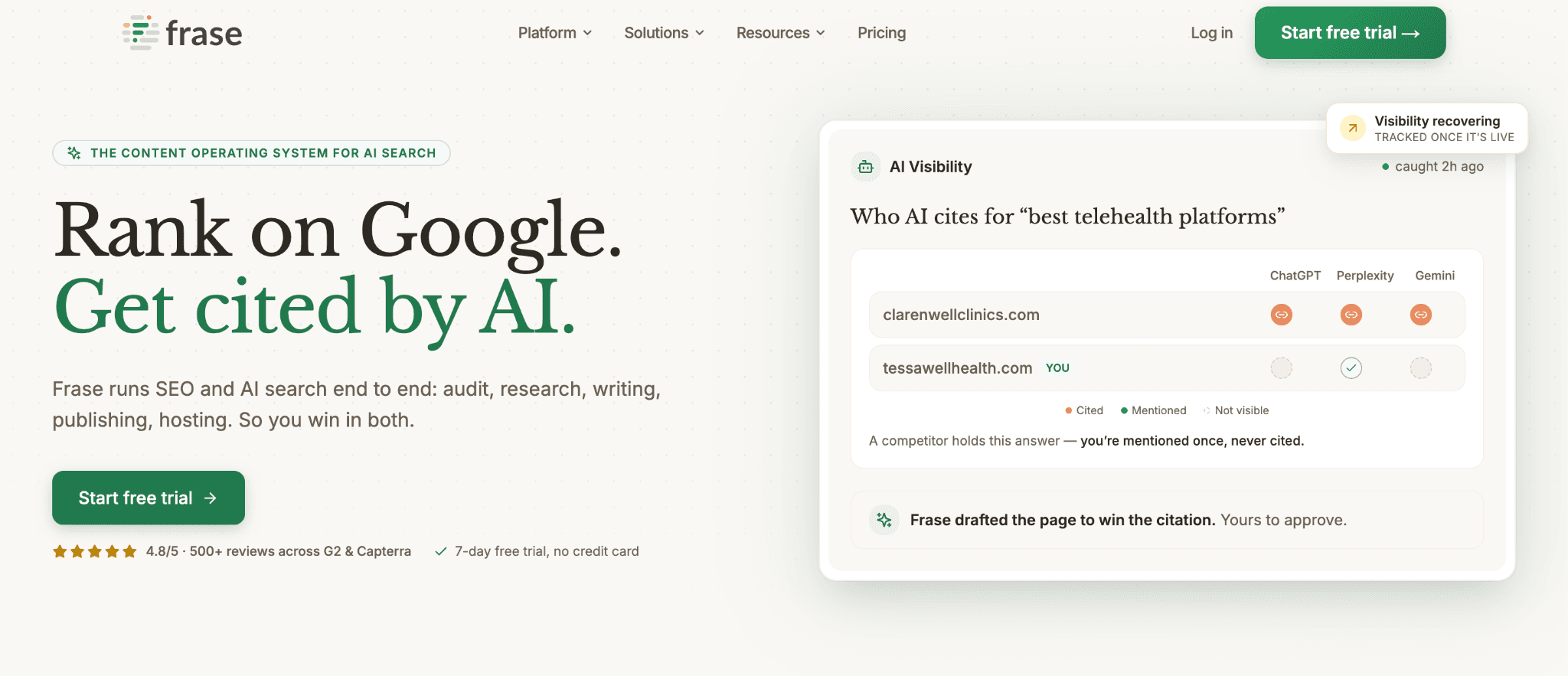
Frase builds briefs from SERP data, then carries them through to a draft without changing tools. Research, brief, and draft sit in a single workflow, which suits teams publishing weekly. It optimizes against the current SERP, so a team buying it for AI answers is measuring a different surface.

Pros

  • SERP research, brief, and draft in one workflow

  • Article allowances are generous across all three tiers

  • Entry tier at $49 matches Surfer's

Cons

  • No AI engine tracking at any tier

  • Optimizes against the current SERP, not AI answer extraction

  • The $299 top tier still includes no visibility tracking

5. NEURONwriter

5.png

Website

neuronwriter.com 

Pricing range

$23 to $117

Best feature

  • NLP term guidance and content scoring

  • AI-monitored questions across Google, AI Overviews, ChatGPT, Perplexity, and AI Mode

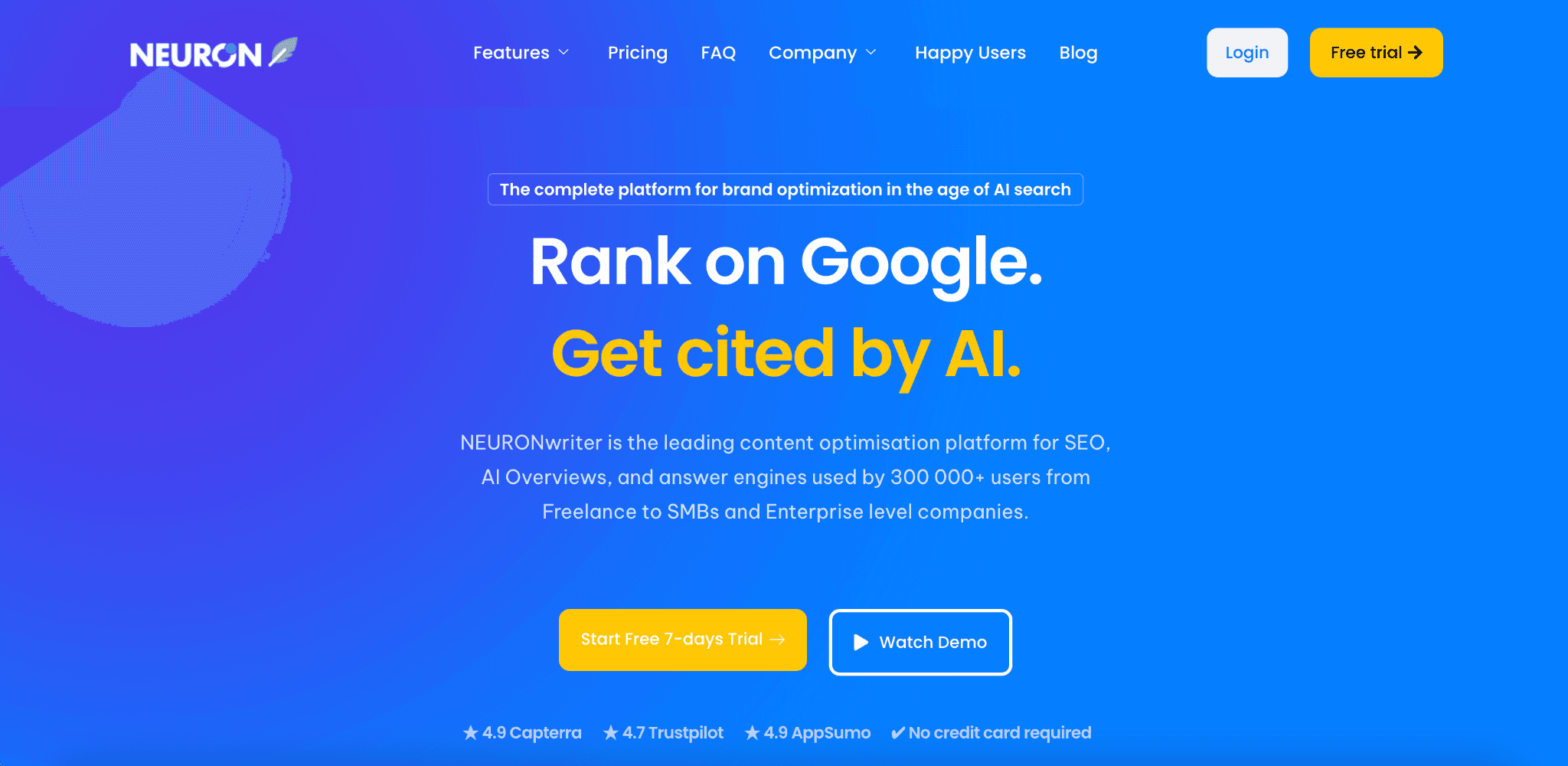
NEURONwriter provides NLP-driven term guidance and content scoring from $23 a month. Five published tiers mean cost scales in small steps rather than doubling between plans. It covers content optimization only, and adds nothing on the AI visibility side at any price.

Pros

  • Lowest entry price in this comparison at $23

  • Five published tiers, so cost scales in small increments

  • NLP term guidance included at every tier

Cons

  • No AI engine tracking at any tier

  • The $117 top tier adds volume rather than visibility features

  • Fewer published features than Surfer at a comparable price

6. Semrush

6.png

Website

semrush.com 

Pricing range

$139 to $549

Best feature

  • Keyword research and rank tracking

  • AI visibility across Google, ChatGPT, Perplexity, and Gemini

  • Site audit and competitor analysis

Semrush combines keyword research, rank tracking, and AI search visibility in one place. It is the only product here where both jobs sit in a single subscription, which removes the reconciliation work of running two vendors. The advertised entry price is the detail to watch, because it contains none of the AI features the product is marketed on.

Pros

  • Tracks Google, ChatGPT, Perplexity, and Gemini in one product

  • Research and AI visibility available under a single subscription

  • Four published tiers from $139 to $549

Cons

  • The $139 SEO plan includes no AI search at all

  • AI features begin at the $199 Starter tier

  • Highest entry price of the ten tools here

7. Ahrefs

7.png

Website

ahrefs.com 

Pricing range

$29 to $1,499

Best feature

  • Backlink index among the largest in the industry

  • Rank tracking and site audit

  • Brand Radar for AI visibility

Ahrefs remains a reference tool for backlink analysis and organic rank research. For diagnosing why a page underperforms in traditional search, its link data is the reason teams keep the subscription. AI visibility is the part buyers assume is included, and it appears as a separate line on the invoice.

Pros

  • Starter plan at $29 is the second-lowest entry price here

  • Free AI Visibility Checker available for one-off spot checks

  • Backlink index among the largest in the industry

Cons

  • Brand Radar costs $199 a month on top of an existing subscription

  • Research plus AI visibility costs $328 a month at minimum

  • Credit limits apply on the lower tiers

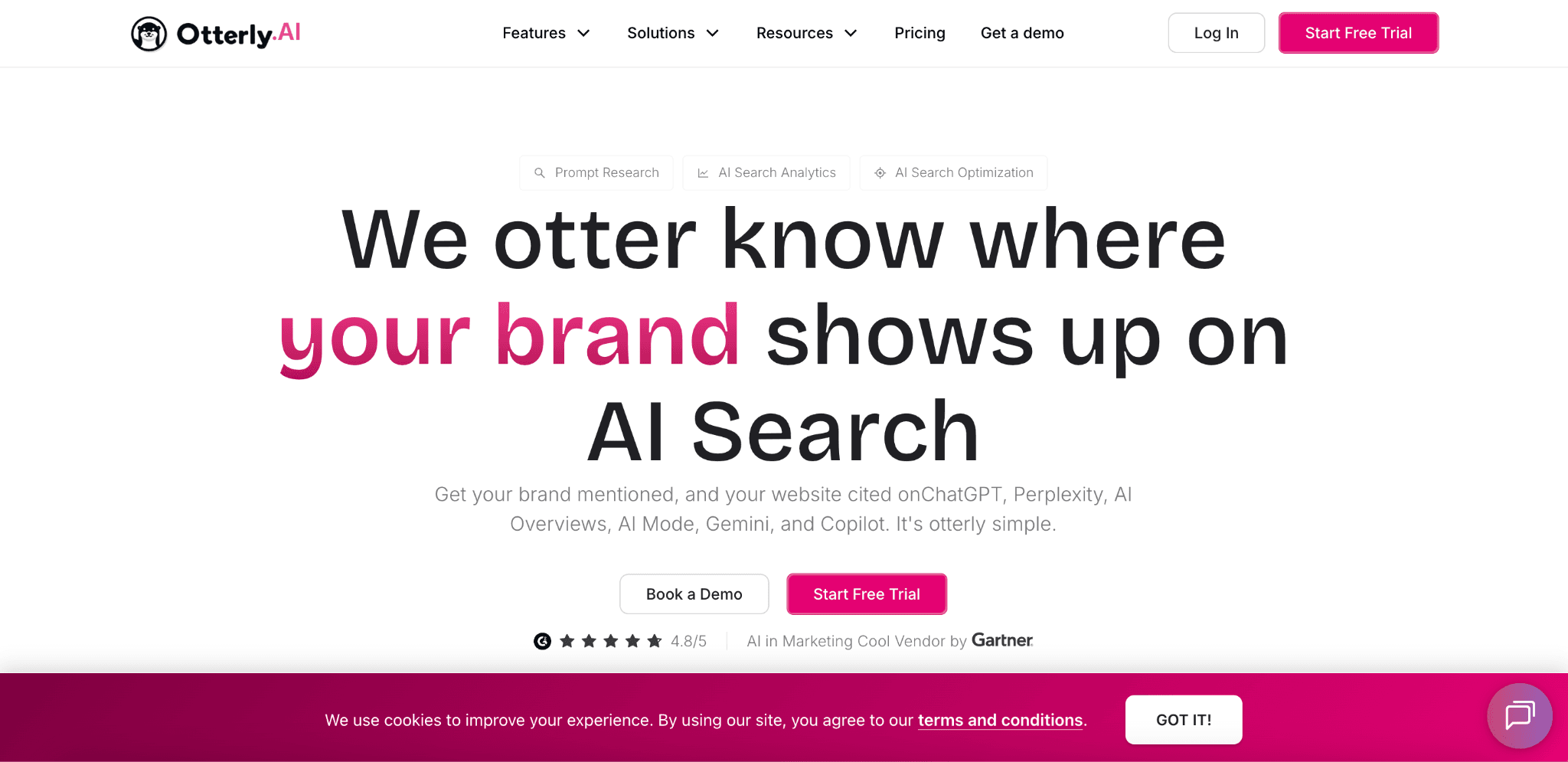
8. Otterly.ai

8.png

Website

otterly.ai 

Pricing range

$29 to $489. Enterprise from $1,000

Best feature

  • Brand tracking across ChatGPT, AI Overviews, Perplexity, and Copilot on every plan

  • Position and sentiment reporting

  • Claude, Gemini, and AI Mode available as add-ons

Otterly tracks brand mentions across AI search engines and reports visibility, position, and sentiment. Every plan covers ChatGPT, Google AI Overviews, Perplexity, and Microsoft Copilot, including the $29 tier. Competitors charge several times more for narrower coverage, though the entry plan's prompt volume is a sample rather than a monitoring programme.

Pros

  • Four engines covered on all plans, including the $29 Lite tier

  • Lowest entry price of any AI visibility tool here

  • Position and sentiment reporting included

Cons

  • Lite tracks 15 prompts, which is a sample rather than monitoring

  • Meaningful coverage starts at $189 for 100 prompts

  • No content optimization features, so it reports absence without a fix

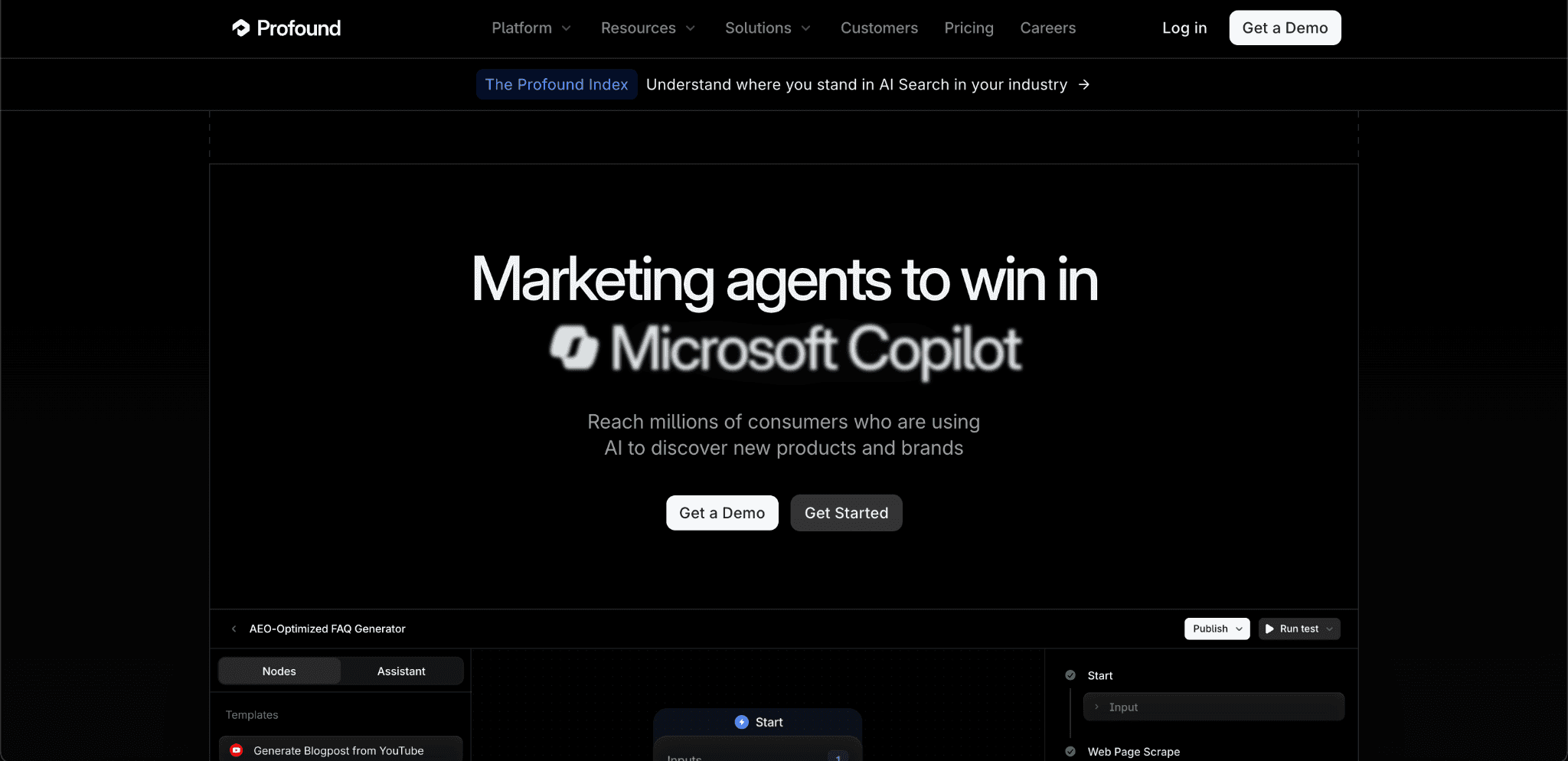
9. Profound

9.png

Website

tryprofound.com 

Pricing range

$99 to $399. Enterprise on request

Best feature

  • Per-prompt reporting across answer engines

  • Custom engine and market coverage on Enterprise

Profound monitors brand presence across answer engines with detailed reporting on each tracked prompt. For large brands running ongoing visibility programmes, that reporting depth is what the price buys. The entry tier is hard to justify against cheaper competitors, because it covers a single engine.

Pros

  • Detailed per-prompt reporting built for ongoing programmes

  • Growth tier covers three engines

  • Enterprise tier supports custom engine and market coverage

Cons

  • The $99 Starter plan covers ChatGPT only, across 50 prompts

  • Three engines do not arrive until Growth at $399

  • Otterly covers four engines at $29

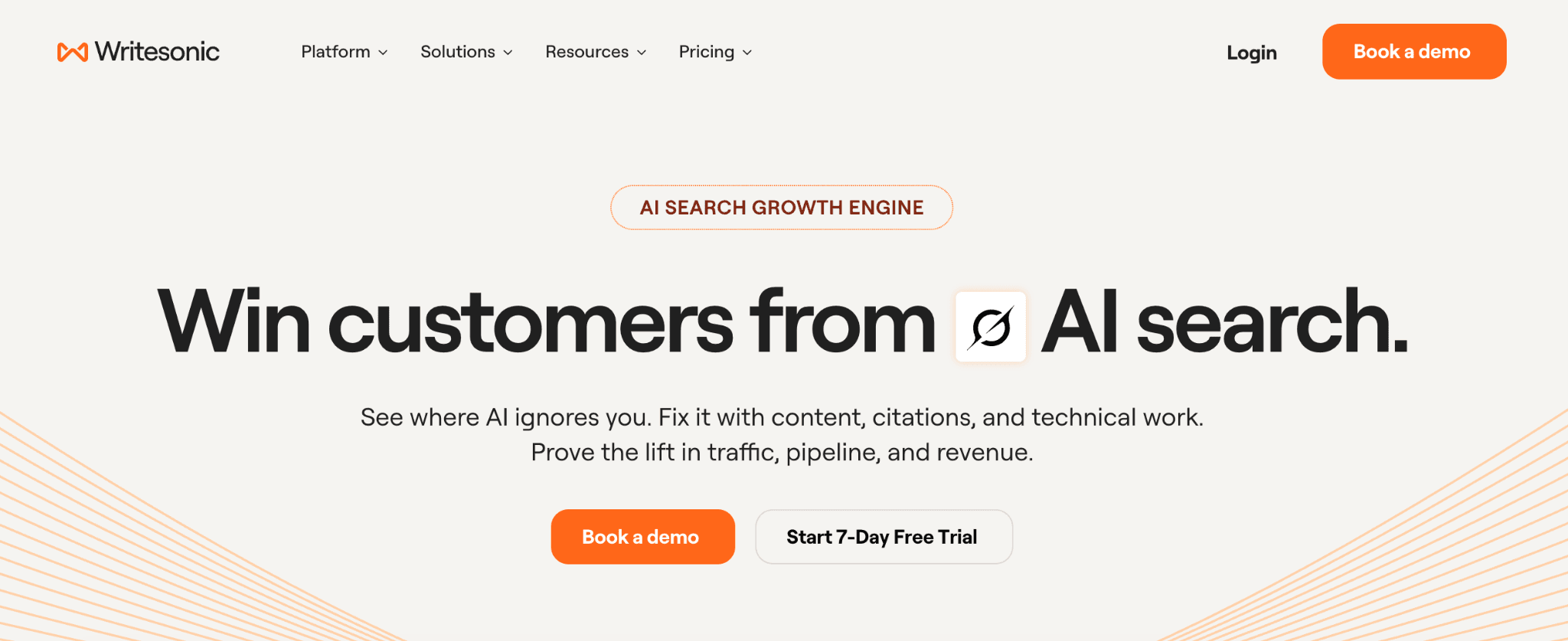
10. Writesonic

10.png

Website

writesonic.com 

Pricing range

$95 to $499

Best feature

  • AI visibility tracking across ChatGPT, Gemini, and AI Overviews

  • Sentiment analysis included at Growth

  • Content generation 

Writesonic pairs AI visibility tracking with content generation, which removes a vendor from the stack. Sentiment analysis and daily refresh arrive at the top published tier. The engine count in its marketing belongs to Enterprise alone, which is the detail most buyers miss.

Pros

  • Tracking and content generation under one subscription

  • Growth tier tracks 200 prompts refreshed daily

  • Sentiment analysis included at $499

Cons

  • Published tiers cover three engines, not the ten advertised

  • Perplexity, Claude, and Copilot require an Enterprise quote

  • Entry price of $95 is high for tracking alone

Which AI SEO Tool Fits Which Team

Solo Operator or Small Agency
One person writing and publishing does not need two subscriptions doing the same job. Pair TMX Visibility for draft scoring with NEURONwriter for term guidance and AI monitoring. NEURONwriter's monitored questions cover Google, AI Overviews, ChatGPT, and Perplexity, which is broader engine coverage than several much larger tools offer.

B2B SaaS Content Team
A team publishing regularly needs to know whether AI answers mention the brand, not only whether pages rank. TMX Visibility handles the draft before it publishes, while Otterly tracks prompts across four engines afterwards. This keeps optimization and measurement in separate tools that each do one job properly.

Ecommerce
Product and category pages still live or die on the results page, so SERP-driven editing matters more here than draft scoring. Surfer grades pages against what currently ranks and tracks five engines daily, while Otterly adds a second view of brand visibility across four engines.

Enterprise
Large teams need research depth, structured reporting, and a vendor they can call. Semrush covers keyword research, rank tracking, and AI visibility under one subscription, while Profound adds detailed per-prompt reporting across three engines. The value here is consolidation and accountability more than raw capability.

The pattern holds at every size. Pair one optimization tool with one tracking tool, and skip the all-in-one until a single vendor genuinely covers both jobs at the tier being purchased.

What to Look For and What to Avoid

Every tool in this category sounds capable on its own website, and the real differences only appear when a buyer checks what each vendor states in public. Some publish their pricing, engine coverage, and limits openly, while others describe features without ever attaching a number or a name to them. The table below covers what is worth checking before signing anything.

Look for

Avoid

Published pricing on a public page

Pricing gated behind a demo booking

Engine coverage named per plan tier

"Tracks AI search" with no engine list

Prompt or article volumes stated per tier

Unlimited claims without a definition

A stated limitation in the vendor's own docs

Enterprise features listed beside entry prices

Recommendations specific to the draft

Generic advice reusable on any page

Monthly billing available

Annual-only contracts at the entry tier

Teams that want to score a draft before publishing and track its AI citations afterwards can run it through TMX Visibility at visibility.tmx.center. The free plan carries all ten scorers and five tracked articles, which is enough to test the workflow before committing a budget anywhere.

Optimize Drafts to Outrank Competitors With TMX Visibility

Publishing an article is no longer the finish line. It has to rank on Google, hold up inside AI answers, and show that it brought in something measurable. Most teams only learn how a piece performed weeks after it went live, when changing it costs far more.

TMX Visibility works on a draft before it publishes, then follows it afterwards. It scores information gain, maps entity coverage, marks the weak sections a writer needs to rewrite, and compares the draft against named competitor URLs. Once the article is live, it tracks AI citations and average AI rank, and connects both to GA4 sessions and conversions.

Teams get a 0 to 100 Visibility Score before an article publishes, and the revenue it generated after. Optimize a draft with TMX Visibility.

FAQs

  1. Can an AI SEO tool replace an SEO agency?
    No. Tools report problems and suggest fixes. They do not diagnose why a site underperforms, prioritise work against business goals, or ship changes. A team with in-house capacity gains most from tools. A team without one is buying a dashboard nobody acts on.

  2. Is there a free AI SEO tool?
    Yes. TMX Visibility's free plan includes all ten draft scorers and five tracked articles with weekly sync. Ahrefs offers a free AI Visibility Checker for one-off checks, and Ahrefs Webmaster Tools covers basic site data. Free tiers elsewhere are trials rather than working plans.

  3. Does ChatGPT work as an AI SEO tool?
    Partly. It drafts and restructures content well, and it costs little. It cannot report keyword volume, track rank, or show whether a brand appears in anyone else's AI answers. It is a writing tool that sits beside an SEO stack rather than inside it.

  4. Do AI SEO tools actually improve rankings?
    Indirectly. No tool changes a ranking. Tools that grade extractability and entity coverage make a page easier for engines to parse and cite, which correlates with visibility. Tools that only report brand mentions change nothing without editorial work behind them.

  5. How long before results show?
    Content optimization changes appear within weeks, since the page is re-crawled and re-scored. AI citation changes move slower and less predictably, because answer engines refresh their sources on their own schedules. Three months is a fair first review point.


TL;DR
We checked the published pricing and documentation of ten AI SEO tools in 2026. The category now covers three separate jobs, and no single tool covers all three. TMX Visibility covers both content optimization and article-level AI visibility tracking. Surfer SEO, Clearscope, Frase, and NEURONwriter focus primarily on content optimization, while Otterly, Profound, and Writesonic specialize in AI citation tracking. Entry prices run from free to $139 a month. The right choice depends on which job the existing stack leaves unfilled.

Our Top Pick

TMX Visibility stands out as our top pick for content optimization and AI visibility tracking. It gives every draft a 0 to 100 Visibility Score before publication, so a team knows whether an article is strong enough to compete before it goes live. After publishing, it connects AI citations back to GA4 revenue rather than traffic alone, which is what turns content reporting into a business case. This tool is ideal for teams focused on outranking competitors in AI answers and proving content ROI.

Disclosure: TMX Visibility is developed by TokenMinds. We have identified it as the top option for draft optimization and GA4-linked AI performance tracking, based on the four criteria in the methodology section.

Why AI SEO Tools Matter in 2026

Google now answers many questions directly on the search results page. It allows users to read the answers without clicking through to a link. Publishers were the first to feel the impact. A Chartbeat study reported by Axios found that over two years, small publishers lost 60% of search traffic, medium-sized publishers lost 47%, and large publishers lost 22%.

Google acknowledged this issue. Google has explored various ways to integrate publisher content, including displaying links from publications to which readers were already subscribed in certain contexts. While various AI SEO tools on the market offer solutions to this problem, many teams end up purchasing the wrong ones.

For instance, a team already using Surfer purchases Clearscope, resulting in two tools evaluating the same draft, and neither tool can detect whether ChatGPT mentions their brand. Ultimately, the key question is not which tool is best, but rather what work remains unaddressed.

What Are the Best AI SEO Tools in 2026?

The best AI SEO tool depends on which of the three jobs a team needs filled. For optimizing content before it publishes, TMX Visibility scores drafts against ten named axes on a free plan. For keyword and rank research with AI search included, Semrush is the only tool here that combines both in a single subscription. For tracking brand visibility inside AI answers, Otterly covers four engines from $29 a month.

Every AI marketing tool below publishes its pricing, while three well-known tools do not, and those three were excluded for that reason. Below is an overview of the ten tools, covering the job each one performs, where its pricing starts, and the situation it suits best:

Tool

Job

Starts at

Best for

TMX Visibility

Content optimization and AI visibility

Free

AI visibility scoring before publish

Surfer SEO

Content optimization

$49

SERP-driven on-page editing

Clearscope

Content optimization

$129

Term coverage grading

Frase

Briefs and workflow

$49

Fast brief-to-draft production

NEURONwriter

Content optimization

$23

Optimizing on a tight budget

Semrush

Research and AI search

$139

One subscription for both jobs

Ahrefs

Research and backlinks

$29

Link and rank data

Otterly.ai

AI visibility

$29

Widest engine coverage, lowest entry

Profound

AI visibility

$99

Enterprise prompt analysis

Writesonic

AI visibility and content

$95

Tracking and content in one place

What an AI SEO Tool Does That a Traditional SEO Tool Does Not

The label now covers three jobs that used to be one. So before paying for any tool, a team needs to know which of those jobs it actually does.

  • Keyword and rank research is the traditional job, where the tool finds terms, estimates volume, and reports position in Google. Semrush and Ahrefs have owned this category for a decade, and nothing in the newer wave of products threatens them there.

  • Content optimization for extractability is the second job. Here the tool reads a draft and reports what a search engine or a language model would struggle to pull out of it, which covers entity coverage, term depth, structure, and source verifiability.

  • AI visibility tracking is the newest job. These tools run prompts against ChatGPT, Perplexity, Gemini, and others, then report whether a brand appears in the answers.

Job

What it reports

Tools that do it

What it does not solve

Research

Volume, difficulty, rank

Semrush, Ahrefs

Whether the page is extractable

Content optimization

Draft quality before publish

TMX, Surfer, Clearscope, Frase, NEURONwriter

Whether a model cites the brand

AI visibility

Brand presence in AI answers

TMX, Otterly, Profound, Writesonic

Which specific edits will change the outcome

How We Compared These 10 Tools

We checked every vendor's pricing page and published documentation in August 2026, and each tool is described by what its own materials state rather than by what its marketing summarises. Each tool was assessed against four criteria.

  • Jobs covered. How many of the three jobs the product performs.

  • Cost to reach the core capability. What a team pays before the main feature is usable.

  • Transparency. Whether pricing, engine coverage, and limits are published.

  • Prescriptive or descriptive. Whether the tool says what to change, or only reports a result.

All figures are monthly list prices rather than annual-discount rates, because annual framing makes a tool look cheaper than the first invoice does.

The 10 Best AI SEO Tools in 2026

1. TMX Visibility

1.png

Website

visibility.tmx.center

Pricing range

Free, Pro $199, and Business $499 

Best feature

  • Information gain to show how much new material the draft adds

  • Entity coverage to flag topics and names the draft is missing

  • Section-level scoring to mark which blocks need rewriting

  • Outrank scoring to compare the draft against competitor URLs

  • AI citation tracking to show where the article lands in AI answers

TMX Visibility helps writers optimize a draft so it can rank on Google and appear in AI answers. In our testing, we uploaded a draft on 'Web3 marketing strategies.' TMX Visibility flagged a missing entity 'decentralized autonomous organizations (DAOs)' and suggested adding a section on their role in Web3 governance. It also highlighted a paragraph on 'token utility' as having low information gain compared to top-ranking articles, prompting a rewrite to include more concrete examples. The tool then generated machine-readable JSON for the article, which helps search engines and AI models parse the page cleanly.

After publishing, the app tracks AI citations and average AI rank, then connects article performance to GA4 sessions, conversions, and revenue. This way an article is not just published, but optimized for AI and measured afterwards.

TMX Visibility's free plan offers essential article optimization scorers, including AI detection and source verifiability, making it accessible for testing workflows before budget commitments.

Disclosure: TMX Visibility is a TokenMinds product.

Pros

  • All article optimization scorers available on the free plan, including AI detection and source verifiability

  • Article performance tracking, with AI citations connected to GA4 sessions and conversions

  • JSON-LD schema generation on Pro

Cons

  • No keyword research, backlink analysis, or site crawling

  • Reports article-level visibility rather than per-engine share of voice

2. Surfer SEO

2.png

Website

surferseo.com 

Pricing range

$49 to $299. Enterprise $999

Best feature

  • Live content editor that regrades against currently ranking pages

  • AI prompt tracking, 25 to 100 prompts depending on tier

  • Mention gap, brand sentiment, and share of voice

Surfer grades a draft against the pages currently ranking, then guides edits in a live editor. In our test, we used Surfer to optimize an article on 'B2B content marketing trends.' The tool recommended increasing the word count by 300 words and suggested adding terms like 'account-based marketing (ABM)' and 'thought leadership' based on top-ranking SERPs. Its term guidance is tied to a specific SERP rather than to general best practice, which is what separates it from cheaper optimizers. The AI tracking is where the tiers matter, because the plan most teams pick covers a single engine.

Pros

  • Content editor regrades a draft against currently ranking pages

  • AI Search Analytics sold standalone at $158 for tracking without the editor

  • Four published tiers between $49 and $299

Cons

  • The $99 Standard plan covers ChatGPT only, refreshed weekly

  • Multi-engine daily tracking starts at the $182 Pro tier

  • Enterprise pricing jumps to $999

3. Clearscope

3.png

Website

clearscope.io 

Pricing range

$129 to $399

Best feature

  • Term coverage reported as a single letter grade

  • Prompt tracking across ChatGPT and Gemini, 50 to 300 prompts

  • Query fan-out view showing the searches AI runs to build an answer

Clearscope grades content on how completely it covers the terms a topic requires. For instance, when we ran a draft about 'blockchain in supply chain' through Clearscope, it assigned a 'B+' grade and highlighted terms like 'smart contracts' and 'traceability' as underutilized. The report is designed to be actionable without SEO training, which suits teams briefing freelance writers. That simplicity comes at a price above tools that do more, and the product covers only one of the three jobs.

Pros

  • Term coverage reported as a single letter grade

  • Two published tiers with no enterprise gate below $399

  • Reports readable by writers with no SEO background

Cons

  • At $129, the entry plan costs more than Surfer, Frase, and NEURONwriter

  • AI engine coverage is not published anywhere public

  • No AI visibility tracking at either tier

4. Frase

4.png

Website

frase.io 

Pricing range

$49 to $299

Best feature

  • SERP research, brief, and draft in one workflow

  • Content optimization against currently ranking pages

  • AI writing built into the editor

Frase builds briefs from SERP data, then carries them through to a draft without changing tools. Research, brief, and draft sit in a single workflow, which suits teams publishing weekly. It optimizes against the current SERP, so a team buying it for AI answers is measuring a different surface.

Pros

  • SERP research, brief, and draft in one workflow

  • Article allowances are generous across all three tiers

  • Entry tier at $49 matches Surfer's

Cons

  • No AI engine tracking at any tier

  • Optimizes against the current SERP, not AI answer extraction

  • The $299 top tier still includes no visibility tracking

5. NEURONwriter

5.png

Website

neuronwriter.com 

Pricing range

$23 to $117

Best feature

  • NLP term guidance and content scoring

  • AI-monitored questions across Google, AI Overviews, ChatGPT, Perplexity, and AI Mode

NEURONwriter provides NLP-driven term guidance and content scoring from $23 a month. Five published tiers mean cost scales in small steps rather than doubling between plans. It covers content optimization only, and adds nothing on the AI visibility side at any price.

Pros

  • Lowest entry price in this comparison at $23

  • Five published tiers, so cost scales in small increments

  • NLP term guidance included at every tier

Cons

  • No AI engine tracking at any tier

  • The $117 top tier adds volume rather than visibility features

  • Fewer published features than Surfer at a comparable price

6. Semrush

6.png

Website

semrush.com 

Pricing range

$139 to $549

Best feature

  • Keyword research and rank tracking

  • AI visibility across Google, ChatGPT, Perplexity, and Gemini

  • Site audit and competitor analysis

Semrush combines keyword research, rank tracking, and AI search visibility in one place. It is the only product here where both jobs sit in a single subscription, which removes the reconciliation work of running two vendors. The advertised entry price is the detail to watch, because it contains none of the AI features the product is marketed on.

Pros

  • Tracks Google, ChatGPT, Perplexity, and Gemini in one product

  • Research and AI visibility available under a single subscription

  • Four published tiers from $139 to $549

Cons

  • The $139 SEO plan includes no AI search at all

  • AI features begin at the $199 Starter tier

  • Highest entry price of the ten tools here

7. Ahrefs

7.png

Website

ahrefs.com 

Pricing range

$29 to $1,499

Best feature

  • Backlink index among the largest in the industry

  • Rank tracking and site audit

  • Brand Radar for AI visibility

Ahrefs remains a reference tool for backlink analysis and organic rank research. For diagnosing why a page underperforms in traditional search, its link data is the reason teams keep the subscription. AI visibility is the part buyers assume is included, and it appears as a separate line on the invoice.

Pros

  • Starter plan at $29 is the second-lowest entry price here

  • Free AI Visibility Checker available for one-off spot checks

  • Backlink index among the largest in the industry

Cons

  • Brand Radar costs $199 a month on top of an existing subscription

  • Research plus AI visibility costs $328 a month at minimum

  • Credit limits apply on the lower tiers

8. Otterly.ai

8.png

Website

otterly.ai 

Pricing range

$29 to $489. Enterprise from $1,000

Best feature

  • Brand tracking across ChatGPT, AI Overviews, Perplexity, and Copilot on every plan

  • Position and sentiment reporting

  • Claude, Gemini, and AI Mode available as add-ons

Otterly tracks brand mentions across AI search engines and reports visibility, position, and sentiment. Every plan covers ChatGPT, Google AI Overviews, Perplexity, and Microsoft Copilot, including the $29 tier. Competitors charge several times more for narrower coverage, though the entry plan's prompt volume is a sample rather than a monitoring programme.

Pros

  • Four engines covered on all plans, including the $29 Lite tier

  • Lowest entry price of any AI visibility tool here

  • Position and sentiment reporting included

Cons

  • Lite tracks 15 prompts, which is a sample rather than monitoring

  • Meaningful coverage starts at $189 for 100 prompts

  • No content optimization features, so it reports absence without a fix

9. Profound

9.png

Website

tryprofound.com 

Pricing range

$99 to $399. Enterprise on request

Best feature

  • Per-prompt reporting across answer engines

  • Custom engine and market coverage on Enterprise

Profound monitors brand presence across answer engines with detailed reporting on each tracked prompt. For large brands running ongoing visibility programmes, that reporting depth is what the price buys. The entry tier is hard to justify against cheaper competitors, because it covers a single engine.

Pros

  • Detailed per-prompt reporting built for ongoing programmes

  • Growth tier covers three engines

  • Enterprise tier supports custom engine and market coverage

Cons

  • The $99 Starter plan covers ChatGPT only, across 50 prompts

  • Three engines do not arrive until Growth at $399

  • Otterly covers four engines at $29

10. Writesonic

10.png

Website

writesonic.com 

Pricing range

$95 to $499

Best feature

  • AI visibility tracking across ChatGPT, Gemini, and AI Overviews

  • Sentiment analysis included at Growth

  • Content generation 

Writesonic pairs AI visibility tracking with content generation, which removes a vendor from the stack. Sentiment analysis and daily refresh arrive at the top published tier. The engine count in its marketing belongs to Enterprise alone, which is the detail most buyers miss.

Pros

  • Tracking and content generation under one subscription

  • Growth tier tracks 200 prompts refreshed daily

  • Sentiment analysis included at $499

Cons

  • Published tiers cover three engines, not the ten advertised

  • Perplexity, Claude, and Copilot require an Enterprise quote

  • Entry price of $95 is high for tracking alone

Which AI SEO Tool Fits Which Team

Solo Operator or Small Agency
One person writing and publishing does not need two subscriptions doing the same job. Pair TMX Visibility for draft scoring with NEURONwriter for term guidance and AI monitoring. NEURONwriter's monitored questions cover Google, AI Overviews, ChatGPT, and Perplexity, which is broader engine coverage than several much larger tools offer.

B2B SaaS Content Team
A team publishing regularly needs to know whether AI answers mention the brand, not only whether pages rank. TMX Visibility handles the draft before it publishes, while Otterly tracks prompts across four engines afterwards. This keeps optimization and measurement in separate tools that each do one job properly.

Ecommerce
Product and category pages still live or die on the results page, so SERP-driven editing matters more here than draft scoring. Surfer grades pages against what currently ranks and tracks five engines daily, while Otterly adds a second view of brand visibility across four engines.

Enterprise
Large teams need research depth, structured reporting, and a vendor they can call. Semrush covers keyword research, rank tracking, and AI visibility under one subscription, while Profound adds detailed per-prompt reporting across three engines. The value here is consolidation and accountability more than raw capability.

The pattern holds at every size. Pair one optimization tool with one tracking tool, and skip the all-in-one until a single vendor genuinely covers both jobs at the tier being purchased.

What to Look For and What to Avoid

Every tool in this category sounds capable on its own website, and the real differences only appear when a buyer checks what each vendor states in public. Some publish their pricing, engine coverage, and limits openly, while others describe features without ever attaching a number or a name to them. The table below covers what is worth checking before signing anything.

Look for

Avoid

Published pricing on a public page

Pricing gated behind a demo booking

Engine coverage named per plan tier

"Tracks AI search" with no engine list

Prompt or article volumes stated per tier

Unlimited claims without a definition

A stated limitation in the vendor's own docs

Enterprise features listed beside entry prices

Recommendations specific to the draft

Generic advice reusable on any page

Monthly billing available

Annual-only contracts at the entry tier

Teams that want to score a draft before publishing and track its AI citations afterwards can run it through TMX Visibility at visibility.tmx.center. The free plan carries all ten scorers and five tracked articles, which is enough to test the workflow before committing a budget anywhere.

Optimize Drafts to Outrank Competitors With TMX Visibility

Publishing an article is no longer the finish line. It has to rank on Google, hold up inside AI answers, and show that it brought in something measurable. Most teams only learn how a piece performed weeks after it went live, when changing it costs far more.

TMX Visibility works on a draft before it publishes, then follows it afterwards. It scores information gain, maps entity coverage, marks the weak sections a writer needs to rewrite, and compares the draft against named competitor URLs. Once the article is live, it tracks AI citations and average AI rank, and connects both to GA4 sessions and conversions.

Teams get a 0 to 100 Visibility Score before an article publishes, and the revenue it generated after. Optimize a draft with TMX Visibility.

FAQs

  1. Can an AI SEO tool replace an SEO agency?
    No. Tools report problems and suggest fixes. They do not diagnose why a site underperforms, prioritise work against business goals, or ship changes. A team with in-house capacity gains most from tools. A team without one is buying a dashboard nobody acts on.

  2. Is there a free AI SEO tool?
    Yes. TMX Visibility's free plan includes all ten draft scorers and five tracked articles with weekly sync. Ahrefs offers a free AI Visibility Checker for one-off checks, and Ahrefs Webmaster Tools covers basic site data. Free tiers elsewhere are trials rather than working plans.

  3. Does ChatGPT work as an AI SEO tool?
    Partly. It drafts and restructures content well, and it costs little. It cannot report keyword volume, track rank, or show whether a brand appears in anyone else's AI answers. It is a writing tool that sits beside an SEO stack rather than inside it.

  4. Do AI SEO tools actually improve rankings?
    Indirectly. No tool changes a ranking. Tools that grade extractability and entity coverage make a page easier for engines to parse and cite, which correlates with visibility. Tools that only report brand mentions change nothing without editorial work behind them.

  5. How long before results show?
    Content optimization changes appear within weeks, since the page is re-crawled and re-scored. AI citation changes move slower and less predictably, because answer engines refresh their sources on their own schedules. Three months is a fair first review point.

GET SUCCESS IN WEB3

  • Trusted Web3 partner since 2017

  • Full-stack Web3 development team

  • Performance-driven Web3 marketing

Get A Free Consultation

Get A Free Consultation

MEET US AT

RECENT TRAININGS

Follow us

get web3 business updates

Email invalid

  • Access global liquidity for your RWA project with TMX Tokenize’s Canton Network integration

DISCOVER NOW

  • Access global liquidity for your RWA project with TMX Tokenize’s Canton Network integration

    JOIN NOW

DISCOVER

  • Access global liquidity for your RWA project with TMX Tokenize’s Canton Network integration