Web3 & AI

SOLUTIONS

Products

Services

Web3 & AI

SOLUTIONS

Services

Products

Industries

Become Our Client

About Us

Resources

Web3 & AI

SOLUTIONS

Services

Products

Industries

Token Sale Investor Update Template: What to Send Before a Public Round

Token Sale Investor Update Template: What to Send Before a Public Round

TL;DR: A token sale investor update is a structured briefing sent before a public round. A useful update covers product proof, token utility, sale terms, timeline, risks, official links, support, and next steps. It follows the same section order every time and makes no price promises. Teams that publish this early answer questions before they become support tickets, and they leave less room for scam impersonators.

Public rounds now face more scrutiny than at any point in recent years. According to CryptoRank data, public crypto token sales raised just $58 million in Q2 2026, a drop of 85% from the previous quarter. That puts the period on track to become the weakest quarter for ICOs, IDOs, and IEOs in five years. Deal count is shrinking just as fast. The same CryptoRank release shows public sales fell from 105 in Q1 to 37 in Q2, and May recorded just 13, the lowest monthly count since December 2020.

Fewer sales and pickier buyers mean each launch gets evaluated harder. This is where crypto investor outreach either works or fails. A hype-heavy update with missing sale terms slows evaluation and erodes trust. A clear, repeatable update does the opposite. This article breaks down what to send, when to send it, and provides a copy-ready template.

What Is a Token Sale Investor Update?

A token sale investor update is a recurring briefing that helps investors and buyers evaluate a launch before the public round opens. It is the pre-sale communication layer of the wider token sale process, sitting between the private round close and TGE.

It differs from a standard startup investor update in one key way. Writing for Forbes, Alejandro Cremades frames investor updates as post-funding reporting to existing VCs. A token sale update serves that audience too, but it must also work for public buyers who have never spoken to the team. The core items translate as follows.

The table below maps the Forbes startup update structure to its token sale equivalent. Each item keeps its purpose but shifts toward launch evidence.

Forbes startup update item

Token sale equivalent

Summary of the last period

Progress since the private round

Product launches

Product proof: mainnet, users, audits

Milestones achieved and pending

Roadmap status against the whitepaper

Asks and open items

Next steps and asks for backers

Runway

Sale terms, caps, and vesting

Summary of metrics

On-chain and product metrics

The structure carries over. The content shifts from runway reporting to launch evidence in every section.

Why Do Investor Updates Build Trust Before TGE?

Updates build trust because they make the sale easy to verify. Teams using a standardized update format often report fewer pre-sale support inquiries and shorter investor evaluation cycles, typically compressing from weeks to days. That trust shows up in three measurable ways before the round opens.

  • Faster evaluation. When terms, proof, and dates sit in one document, an investor does not need three calls to form a view. The decision moves at the speed of reading, not scheduling.

  • Lower support load. In practice, many pre-sale questions repeat across buyers. A good update answers them before they reach the inbox, so the team spends sale week on the launch instead of the ticket queue.

  • Reduced scam risk. Impersonators thrive when official links are scattered. An update that always states the verified channels gives buyers one source of truth to check against.

The same Forbes analysis points to a fourth trust builder. Teams that admit problems openly earn more trust, not less, because experienced investors uncover the risks during diligence anyway. The real choice is not whether the risks surface, but who frames them first, and early disclosure reads as command of the project while silence reads as evasive. This is why the template later in this article treats the risks section as a fixed item rather than an optional one.

When Should Teams Send Updates Before a Public Round?

A tight cadence works better than a single announcement. Vegtic notes that monthly is the default cadence for investor updates between pre-seed and series A, but a public round compresses that rhythm into weeks. Buyers decide in the final stretch, so the updates need to land where the decisions happen.


When Should Teams Send Updates Before a Public Round?.png

The timeline below shows a cadence a token sale project can use from private round close to sale day. Each send has one clear purpose.

Timing

Purpose

Private round close

Recap the raise, set the path to TGE

T-30 days

Full sale terms, timeline, and risks

T-14 days

Whitelist and KYC instructions

T-7 days

Final terms confirmation, official links

T-48 hours

Step-by-step participation guide

Sale day

Live status and support channels

Every update repeats the official links and the anti-scam notice. Repetition here is protection, not noise. The cadence also connects to the broader promotion plan, since token sale marketing strategies for pre-sales need the same dates and terms the updates publish. One calendar should drive both. If volatility, a competitor round, or regulatory news disrupts the sale window, teams can merge the T-14 and T-7 updates into a single T-10 send or add one unscheduled notice naming the impact.

What Should a Token Sale Investor Update Include?

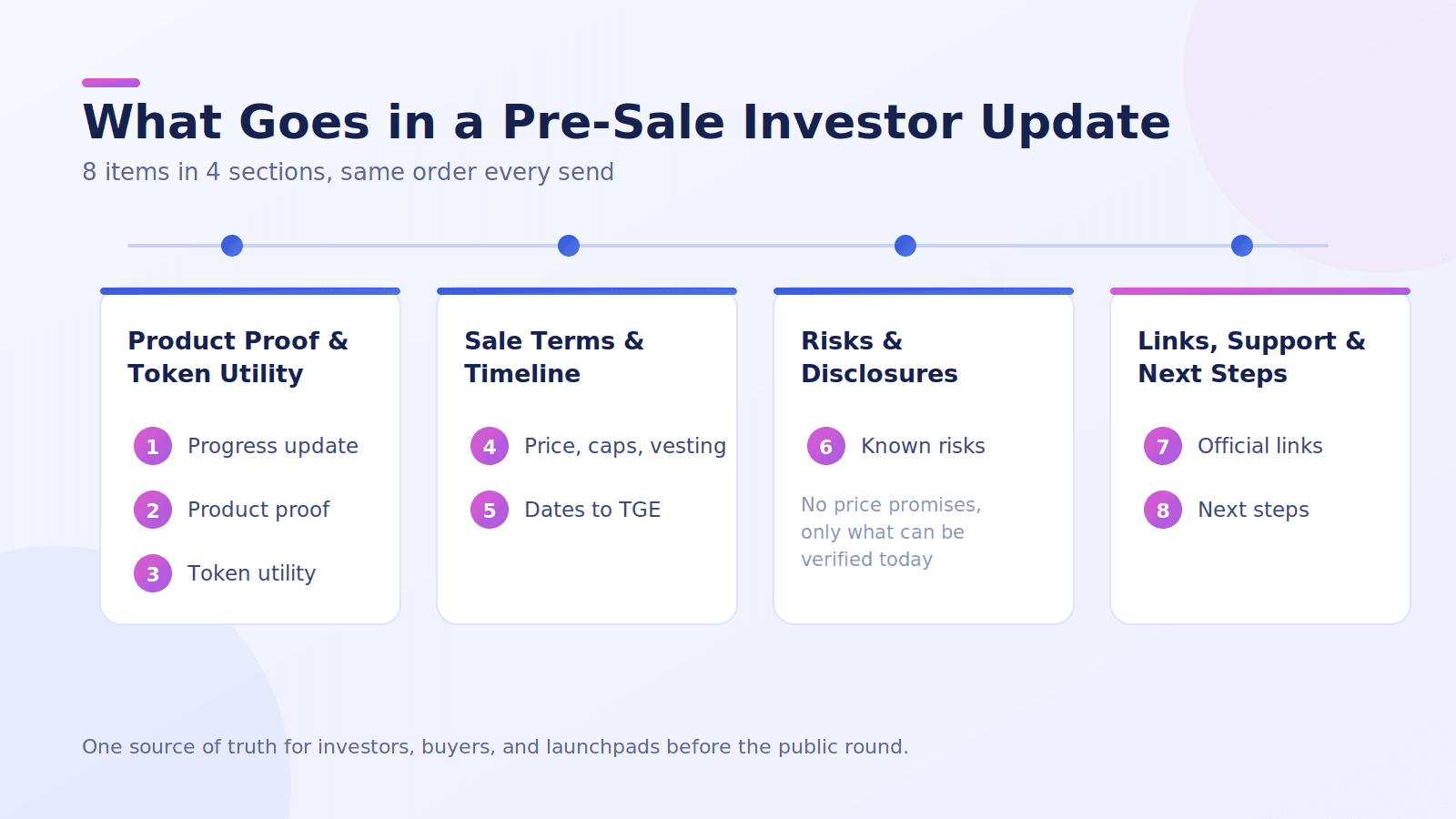
A complete update covers eight items, from progress summary to next steps. The four sections below group them in the order they should appear, each with a preview of how the lines read in practice. Keeping the same order in every send matters. A reusable format lowers the workload, looks more professional, and lands better with investors, because readers learn where to find each answer.

What Should a Token Sale Investor Update Include?.png

Product Proof and Token Utility

Open with evidence, not vision. State what is live today, from testnet or mainnet status to active users, revenue if any, and completed audits with links. Then explain token utility in plain terms. Buyers should understand what the token does inside the product, such as access, staking, governance, or payments. Utility claims without a live product to point at read as promises, so tie each one to something verifiable.

Example: "Mainnet live since June with 12,400 active wallets. Audit completed by [firm], full report linked. The token pays network fees and unlocks staking tiers."

Sale Terms and Timeline

This section carries the most decision weight, so it must be exact. List the token price, round size, individual caps, accepted assets, KYC requirements, and restricted regions. State the vesting schedule for every allocation, including the team's own. Unlock terms shape post-launch behavior, and a clear token unlock communication plan starts with publishing these numbers before the sale, not after. Close with the full timeline, from whitelist opening and KYC deadline through the sale window, TGE date, claim process, and expected listing.

Example: "Public round price $0.04, round size $2M, cap $5,000 per wallet. Public allocation unlocks 25% at TGE, then linear over 6 months. Team tokens locked 12 months. Whitelist opens May 2, sale runs May 16 to 18, TGE May 30."

Risks and Disclosures

Name the known risks directly. These typically include technical dependencies, pending audits, regulatory uncertainty in key markets, and items that could shift the timeline. Short and honest beats long and vague. This section is also where price expectations get managed, because stating that the team makes no price promises is itself a disclosure. Vesting transparency belongs here too. When Ape in Poker structured its token release with a 36-month vesting schedule, a 12-month team lock, and staggered investor unlocks over 15 months, it gave buyers confidence that the project would not flood the market. Stating these terms upfront in the risks section shows the team has thought through post-launch behavior and prevents the surprise that erodes trust.

Example: "The v2 audit is in progress and may shift the claim date by up to one week. The token is not offered in restricted regions, and the team makes no statements about future price."

Official Links, Support, and Next Steps

End every update the same way. List the official website, contract address, and verified social channels, and state that no other channel is legitimate. Give one support contact and its response window. Then close with next steps, meaning what recipients should do now and what the team will send next. For existing private backers, this is also the place for specific asks, often the most valuable section in the entire update.

Example: "Official links are listed below and on the website. No team member will ever DM first. Complete KYC by May 9. Next update lands at T-7 with final terms."

Token Sale Investor Update Template (Copy-Ready)

The sections above cover what each part of the update should say. The template below puts them together into one complete format. Teams can paste it into email or a shared doc and reuse the same structure for every send until TGE.

Subject: [Project] Pre-Sale Update #[N]: [Days] to Public Round

1. Progress since last update

   [2-3 sentences on shipped work and milestones]

2. Product proof

   Status: [testnet/mainnet] | Users: [number] | Audit: [CertiK or equivalent firm, link]

3. Token utility

   [What the token does in the product, 2-3 sentences]

4. Sale terms

   Price: [x] | Round size: [x] | Cap per buyer: [x]

   Accepted assets: [x] | KYC: [requirement] | Restricted: [regions]

   Vesting: [schedule per allocation]

5. Timeline

   Whitelist: [date] | KYC deadline: [date] | Sale: [window]

   TGE: [date] | Claim: [process] | Listing: [confirmed only]

6. Risks and disclosures

   [Known risks, dependencies, no-price-promise statement]

7. Official links and support

   Site: [URL] | Contract: [address] | Channels: [verified list]

   Support: [contact, response time]

8. Next steps

   [What recipients should do, what comes next]

How Should Updates Differ for VCs, Public Buyers, and Launchpads?

One template does not mean one identical message for everyone. A pre-sale update reaches three different readers, and each one evaluates the sale differently. Private investors check progress against what they were promised in the round. Public buyers decide whether to join at all. Launchpads and exchanges assess whether the project is ready to list. The section order stays fixed, but the depth and the channel shift per reader.

The table below shows what changes for each audience.

Audience

What changes

Channel

Private investors (VCs)

Add metrics detail, runway, and direct asks

Email, data room

Public buyers

Simplify language, lead with terms and anti-scam links

Blog, community channels

Launchpads and exchanges

Add compliance docs and structured data packs

Direct submission

Public buyers need the least detail but the most protection, so the official links section does the heavy lifting there. Launchpads sit at the other end and expect structured documentation before they evaluate anything. The VC version deserves the closest look, because it builds on a relationship that started before the sale.

How VC Updates Extend Earlier Outreach

The update sent to private investors is not a first touch. It continues the reporting rhythm that began during venture capital outreach, when the team first pitched the round. Investors who committed based on a pitch expect the update to track the same claims. When the format matches from outreach through pre-TGE, investors read progress instead of re-learning the project each time.

The Meadow Incubation outreach case shows what that earlier stage looks like in practice. Meadow, a Web3 launchpad on the Sui Network, engaged 55 qualified investor leads through structured outreach. The campaign converted 24 of them and raised over 500,000 USDT in early-stage funding. Two parts of that process carry directly into pre-sale updates. Each lead received customized communication rather than a blast, and a structured follow-up rhythm kept investors engaged after the pitch. A pre-TGE update applies the same two habits to the whole backer list, with the template providing the structure.

What to Leave Out of a Pre-Sale Update

Three things do not belong in any update, no matter the audience.

  • Price predictions and ROI claims.
    These create legal exposure and attract buyers who chase returns instead of the product.

  • Unconfirmed listings or partnerships.
    Announcements that slip break trust, and they slip often. Only confirmed names go in.

  • Hype language.
    It adds no information, and this audience discounts it anyway.

The test is simple. If a claim cannot be verified today, it waits for the update where it can.

Pre-Send Checklist

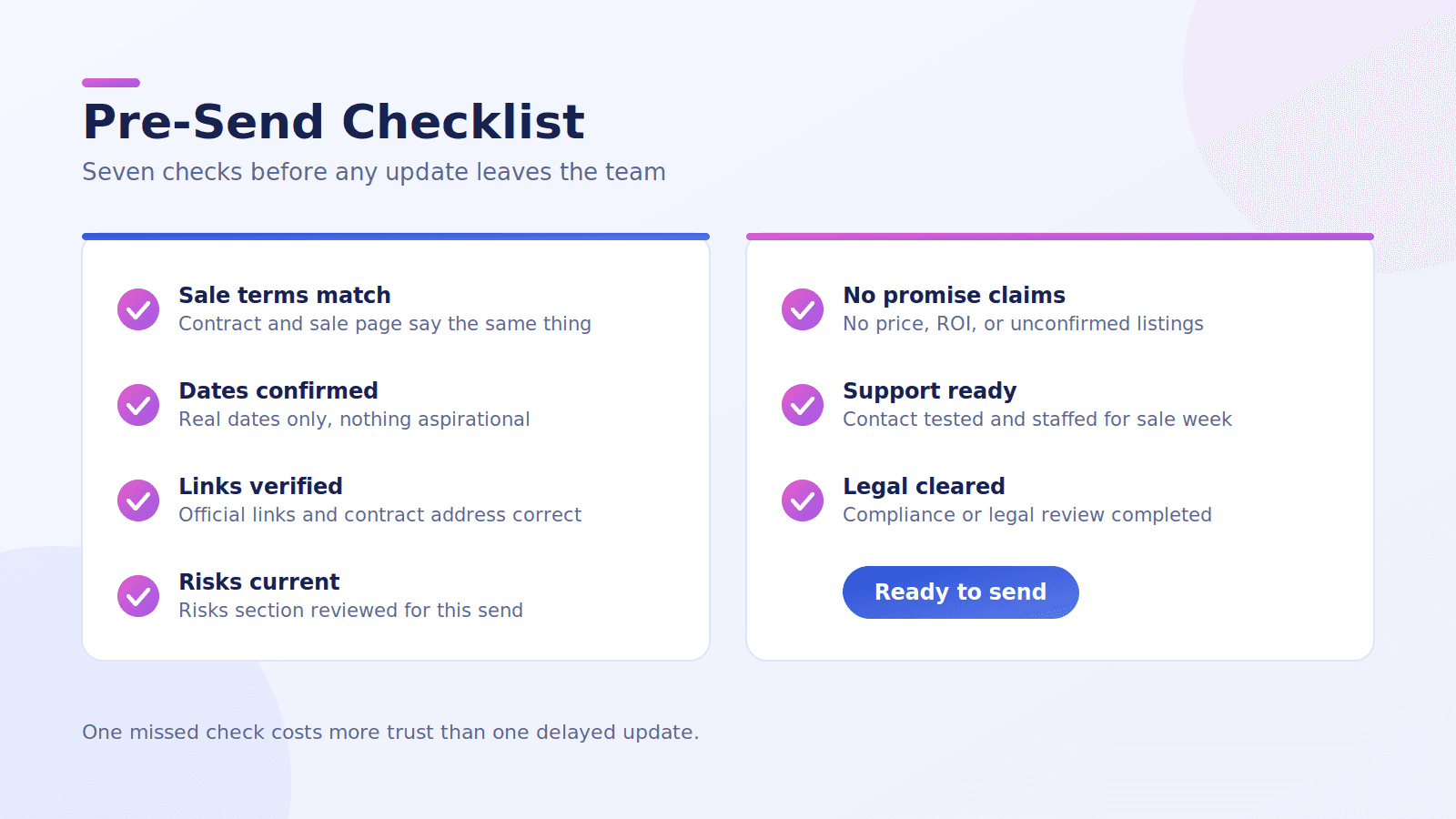
Seven checks confirm an update is ready to leave the team.

  • Sale terms match the contract and the sale page

  • Every date is confirmed, not aspirational

  • Official links and contract address are correct

  • Risks section reviewed and current for this send

  • No price, ROI, or unconfirmed listing claims

  • Support contact tested and staffed for sale week

  • Compliance or legal review completed


Pre-Send Checklist.png

After each send, support ticket volume in the following 48 hours shows which section needs rewriting before the next one. The rhythm should not stop at TGE either. The same discipline continues into a token holder communication calendar after launch, covering unlocks, reporting, and community updates.

Get a Token Sale Update Audit With TokenMinds

A public round is won on clarity, not hype. The sections above show that trust comes from publishing product proof, sale terms, vesting, timeline, risks, and official links before the sale opens, in the same order every time.

TokenMinds has run token sales end to end since 2017, and works on token sale strategy, tokenomics, and go-to-market for Web3 projects heading into a public round. The work covers tokenomics built to survive investor scrutiny, a single sale narrative aligned across decks, website, and community, structured information packs for launchpad and exchange evaluations, and VC outreach that converts. Its token sale update audit checks a project's investor update, sale page, and launch copy against the template in this article in one pass, so the team walks in with a draft and out with the claims that need evidence, the gaps buyers will ask about, and a fixed section order to reuse until TGE.

Book a token sale update audit with TokenMinds.

FAQs

What should teams send investors before a token sale?
A structured update covering product proof, token utility, sale terms, vesting, timeline, risks, official links, support, and next steps. The same section order repeats in every send, so readers learn where to find each answer.

How often should teams update investors before a public round?
A public round needs a compressed cadence. Sends land at private round close, T-30, T-14, T-7, T-48 hours, and sale day, each with one purpose.

What should a token sale investor update never include?
Price predictions, ROI claims, unconfirmed listings or partnerships, and hype language. If a claim cannot be verified today, it waits for the update where it can.


TL;DR: A token sale investor update is a structured briefing sent before a public round. A useful update covers product proof, token utility, sale terms, timeline, risks, official links, support, and next steps. It follows the same section order every time and makes no price promises. Teams that publish this early answer questions before they become support tickets, and they leave less room for scam impersonators.

Public rounds now face more scrutiny than at any point in recent years. According to CryptoRank data, public crypto token sales raised just $58 million in Q2 2026, a drop of 85% from the previous quarter. That puts the period on track to become the weakest quarter for ICOs, IDOs, and IEOs in five years. Deal count is shrinking just as fast. The same CryptoRank release shows public sales fell from 105 in Q1 to 37 in Q2, and May recorded just 13, the lowest monthly count since December 2020.

Fewer sales and pickier buyers mean each launch gets evaluated harder. This is where crypto investor outreach either works or fails. A hype-heavy update with missing sale terms slows evaluation and erodes trust. A clear, repeatable update does the opposite. This article breaks down what to send, when to send it, and provides a copy-ready template.

What Is a Token Sale Investor Update?

A token sale investor update is a recurring briefing that helps investors and buyers evaluate a launch before the public round opens. It is the pre-sale communication layer of the wider token sale process, sitting between the private round close and TGE.

It differs from a standard startup investor update in one key way. Writing for Forbes, Alejandro Cremades frames investor updates as post-funding reporting to existing VCs. A token sale update serves that audience too, but it must also work for public buyers who have never spoken to the team. The core items translate as follows.

The table below maps the Forbes startup update structure to its token sale equivalent. Each item keeps its purpose but shifts toward launch evidence.

Forbes startup update item

Token sale equivalent

Summary of the last period

Progress since the private round

Product launches

Product proof: mainnet, users, audits

Milestones achieved and pending

Roadmap status against the whitepaper

Asks and open items

Next steps and asks for backers

Runway

Sale terms, caps, and vesting

Summary of metrics

On-chain and product metrics

The structure carries over. The content shifts from runway reporting to launch evidence in every section.

Why Do Investor Updates Build Trust Before TGE?

Updates build trust because they make the sale easy to verify. Teams using a standardized update format often report fewer pre-sale support inquiries and shorter investor evaluation cycles, typically compressing from weeks to days. That trust shows up in three measurable ways before the round opens.

  • Faster evaluation. When terms, proof, and dates sit in one document, an investor does not need three calls to form a view. The decision moves at the speed of reading, not scheduling.

  • Lower support load. In practice, many pre-sale questions repeat across buyers. A good update answers them before they reach the inbox, so the team spends sale week on the launch instead of the ticket queue.

  • Reduced scam risk. Impersonators thrive when official links are scattered. An update that always states the verified channels gives buyers one source of truth to check against.

The same Forbes analysis points to a fourth trust builder. Teams that admit problems openly earn more trust, not less, because experienced investors uncover the risks during diligence anyway. The real choice is not whether the risks surface, but who frames them first, and early disclosure reads as command of the project while silence reads as evasive. This is why the template later in this article treats the risks section as a fixed item rather than an optional one.

When Should Teams Send Updates Before a Public Round?

A tight cadence works better than a single announcement. Vegtic notes that monthly is the default cadence for investor updates between pre-seed and series A, but a public round compresses that rhythm into weeks. Buyers decide in the final stretch, so the updates need to land where the decisions happen.


When Should Teams Send Updates Before a Public Round?.png

The timeline below shows a cadence a token sale project can use from private round close to sale day. Each send has one clear purpose.

Timing

Purpose

Private round close

Recap the raise, set the path to TGE

T-30 days

Full sale terms, timeline, and risks

T-14 days

Whitelist and KYC instructions

T-7 days

Final terms confirmation, official links

T-48 hours

Step-by-step participation guide

Sale day

Live status and support channels

Every update repeats the official links and the anti-scam notice. Repetition here is protection, not noise. The cadence also connects to the broader promotion plan, since token sale marketing strategies for pre-sales need the same dates and terms the updates publish. One calendar should drive both. If volatility, a competitor round, or regulatory news disrupts the sale window, teams can merge the T-14 and T-7 updates into a single T-10 send or add one unscheduled notice naming the impact.

What Should a Token Sale Investor Update Include?

A complete update covers eight items, from progress summary to next steps. The four sections below group them in the order they should appear, each with a preview of how the lines read in practice. Keeping the same order in every send matters. A reusable format lowers the workload, looks more professional, and lands better with investors, because readers learn where to find each answer.


What Should a Token Sale Investor Update Include?.png

Product Proof and Token Utility

Open with evidence, not vision. State what is live today, from testnet or mainnet status to active users, revenue if any, and completed audits with links. Then explain token utility in plain terms. Buyers should understand what the token does inside the product, such as access, staking, governance, or payments. Utility claims without a live product to point at read as promises, so tie each one to something verifiable.

Example: "Mainnet live since June with 12,400 active wallets. Audit completed by [firm], full report linked. The token pays network fees and unlocks staking tiers."

Sale Terms and Timeline

This section carries the most decision weight, so it must be exact. List the token price, round size, individual caps, accepted assets, KYC requirements, and restricted regions. State the vesting schedule for every allocation, including the team's own. Unlock terms shape post-launch behavior, and a clear token unlock communication plan starts with publishing these numbers before the sale, not after. Close with the full timeline, from whitelist opening and KYC deadline through the sale window, TGE date, claim process, and expected listing.

Example: "Public round price $0.04, round size $2M, cap $5,000 per wallet. Public allocation unlocks 25% at TGE, then linear over 6 months. Team tokens locked 12 months. Whitelist opens May 2, sale runs May 16 to 18, TGE May 30."

Risks and Disclosures

Name the known risks directly. These typically include technical dependencies, pending audits, regulatory uncertainty in key markets, and items that could shift the timeline. Short and honest beats long and vague. This section is also where price expectations get managed, because stating that the team makes no price promises is itself a disclosure. Vesting transparency belongs here too. When Ape in Poker structured its token release with a 36-month vesting schedule, a 12-month team lock, and staggered investor unlocks over 15 months, it gave buyers confidence that the project would not flood the market. Stating these terms upfront in the risks section shows the team has thought through post-launch behavior and prevents the surprise that erodes trust.

Example: "The v2 audit is in progress and may shift the claim date by up to one week. The token is not offered in restricted regions, and the team makes no statements about future price."

Official Links, Support, and Next Steps

End every update the same way. List the official website, contract address, and verified social channels, and state that no other channel is legitimate. Give one support contact and its response window. Then close with next steps, meaning what recipients should do now and what the team will send next. For existing private backers, this is also the place for specific asks, often the most valuable section in the entire update.

Example: "Official links are listed below and on the website. No team member will ever DM first. Complete KYC by May 9. Next update lands at T-7 with final terms."

Token Sale Investor Update Template (Copy-Ready)

The sections above cover what each part of the update should say. The template below puts them together into one complete format. Teams can paste it into email or a shared doc and reuse the same structure for every send until TGE.

Subject: [Project] Pre-Sale Update #[N]: [Days] to Public Round

1. Progress since last update

   [2-3 sentences on shipped work and milestones]

2. Product proof

   Status: [testnet/mainnet] | Users: [number] | Audit: [CertiK or equivalent firm, link]

3. Token utility

   [What the token does in the product, 2-3 sentences]

4. Sale terms

   Price: [x] | Round size: [x] | Cap per buyer: [x]

   Accepted assets: [x] | KYC: [requirement] | Restricted: [regions]

   Vesting: [schedule per allocation]

5. Timeline

   Whitelist: [date] | KYC deadline: [date] | Sale: [window]

   TGE: [date] | Claim: [process] | Listing: [confirmed only]

6. Risks and disclosures

   [Known risks, dependencies, no-price-promise statement]

7. Official links and support

   Site: [URL] | Contract: [address] | Channels: [verified list]

   Support: [contact, response time]

8. Next steps

   [What recipients should do, what comes next]

How Should Updates Differ for VCs, Public Buyers, and Launchpads?

One template does not mean one identical message for everyone. A pre-sale update reaches three different readers, and each one evaluates the sale differently. Private investors check progress against what they were promised in the round. Public buyers decide whether to join at all. Launchpads and exchanges assess whether the project is ready to list. The section order stays fixed, but the depth and the channel shift per reader.

The table below shows what changes for each audience.

Audience

What changes

Channel

Private investors (VCs)

Add metrics detail, runway, and direct asks

Email, data room

Public buyers

Simplify language, lead with terms and anti-scam links

Blog, community channels

Launchpads and exchanges

Add compliance docs and structured data packs

Direct submission

Public buyers need the least detail but the most protection, so the official links section does the heavy lifting there. Launchpads sit at the other end and expect structured documentation before they evaluate anything. The VC version deserves the closest look, because it builds on a relationship that started before the sale.

How VC Updates Extend Earlier Outreach

The update sent to private investors is not a first touch. It continues the reporting rhythm that began during venture capital outreach, when the team first pitched the round. Investors who committed based on a pitch expect the update to track the same claims. When the format matches from outreach through pre-TGE, investors read progress instead of re-learning the project each time.

The Meadow Incubation outreach case shows what that earlier stage looks like in practice. Meadow, a Web3 launchpad on the Sui Network, engaged 55 qualified investor leads through structured outreach. The campaign converted 24 of them and raised over 500,000 USDT in early-stage funding. Two parts of that process carry directly into pre-sale updates. Each lead received customized communication rather than a blast, and a structured follow-up rhythm kept investors engaged after the pitch. A pre-TGE update applies the same two habits to the whole backer list, with the template providing the structure.

What to Leave Out of a Pre-Sale Update

Three things do not belong in any update, no matter the audience.

  • Price predictions and ROI claims.
    These create legal exposure and attract buyers who chase returns instead of the product.

  • Unconfirmed listings or partnerships.
    Announcements that slip break trust, and they slip often. Only confirmed names go in.

  • Hype language.
    It adds no information, and this audience discounts it anyway.

The test is simple. If a claim cannot be verified today, it waits for the update where it can.

Pre-Send Checklist

Seven checks confirm an update is ready to leave the team.

  • Sale terms match the contract and the sale page

  • Every date is confirmed, not aspirational

  • Official links and contract address are correct

  • Risks section reviewed and current for this send

  • No price, ROI, or unconfirmed listing claims

  • Support contact tested and staffed for sale week

  • Compliance or legal review completed


Pre-Send Checklist.png

After each send, support ticket volume in the following 48 hours shows which section needs rewriting before the next one. The rhythm should not stop at TGE either. The same discipline continues into a token holder communication calendar after launch, covering unlocks, reporting, and community updates.

Get a Token Sale Update Audit With TokenMinds

A public round is won on clarity, not hype. The sections above show that trust comes from publishing product proof, sale terms, vesting, timeline, risks, and official links before the sale opens, in the same order every time.

TokenMinds has run token sales end to end since 2017, and works on token sale strategy, tokenomics, and go-to-market for Web3 projects heading into a public round. The work covers tokenomics built to survive investor scrutiny, a single sale narrative aligned across decks, website, and community, structured information packs for launchpad and exchange evaluations, and VC outreach that converts. Its token sale update audit checks a project's investor update, sale page, and launch copy against the template in this article in one pass, so the team walks in with a draft and out with the claims that need evidence, the gaps buyers will ask about, and a fixed section order to reuse until TGE.

Book a token sale update audit with TokenMinds.

FAQs

What should teams send investors before a token sale?
A structured update covering product proof, token utility, sale terms, vesting, timeline, risks, official links, support, and next steps. The same section order repeats in every send, so readers learn where to find each answer.

How often should teams update investors before a public round?
A public round needs a compressed cadence. Sends land at private round close, T-30, T-14, T-7, T-48 hours, and sale day, each with one purpose.

What should a token sale investor update never include?
Price predictions, ROI claims, unconfirmed listings or partnerships, and hype language. If a claim cannot be verified today, it waits for the update where it can.

GET SUCCESS IN WEB3

  • Trusted Web3 partner since 2017

  • Full-stack Web3 development team

  • Performance-driven Web3 marketing

Get A Free Consultation

Get A Free Consultation

MEET US AT

RECENT TRAININGS

Follow us

get web3 business updates

Email invalid

  • Access global liquidity for your RWA project with TMX Tokenize’s Canton Network integration

DISCOVER NOW

  • Access global liquidity for your RWA project with TMX Tokenize’s Canton Network integration

    JOIN NOW

DISCOVER

  • Access global liquidity for your RWA project with TMX Tokenize’s Canton Network integration