
Web3 & AI

SOLUTIONS

Products

Services

Web3 & AI

SOLUTIONS

Services

Products

Industries

Become Our Client

About Us

Resources

Web3 & AI

SOLUTIONS

Services

Products

Industries

Liquidity Bootstrapping Pools vs IDO vs Bonding Curve: Which Price Discovery Model Fits a Token Launch?

Liquidity Bootstrapping Pools vs IDO vs Bonding Curve: Which Price Discovery Model Fits a Token Launch?

TL;DR: The launch mechanism decides how a token sale finds its first price, who buys first, and how much capital the treasury must lock up. A liquidity bootstrapping pool starts high and lets the price fall toward fair value, which discourages bots and whales. An IDO sells at a fixed price through a launchpad and trades fairness for speed and reach. A bonding curve prices each token by supply sold and rewards early buyers. No model is safest by default, so the right choice depends on fairness, buyer UX, liquidity, compliance, and the market the team wants after launch.

The First Price Decides More Than the Raise

Most founders treat the token sale format as a fundraising question. How much to raise, on which platform, at what price. The format also answers a harder question. It decides how the market discovers the token's price in its first hours.

That first price matters more than most launch plans admit. Delphi Digital's State of Token Markets report, covering more than 540 tokens launched since 2020, found the average token spends about 70% of its life below launch price. Memento Research's review of 118 token launches in 2025 found 84.7% trading below their token generation event (TGE) valuation, with a median fully diluted valuation (FDV) drop of 71.1%. Starting valuation decided much of that outcome. Launches with an FDV between $25M and $200M did best, with 40% still positive, while all 28 launches above $1B FDV were down, at a median of roughly 81%. A launch that opens at the wrong price rarely recovers.

That is why the choice between a liquidity bootstrapping pool (LBP), an initial DEX offering (IDO) on a decentralized exchange, and a bonding curve deserves the same care as tokenomics. Each model discovers price differently, so each produces a different opening. This article explains how the three work and compares them on the criteria operators care about. It then offers a framework for choosing. Teams still shaping the wider raise can start with this token sale guide for Web3 firms before picking a mechanism.

Why the Launch Mechanism Is a Price Discovery Decision

A launch mechanism is the set of rules a token sale uses to sell tokens. It defines who can buy, at what price, and in what order. Price discovery is the process by which the market settles on what a token is worth. Every launch goes through it, either during the sale or right after.

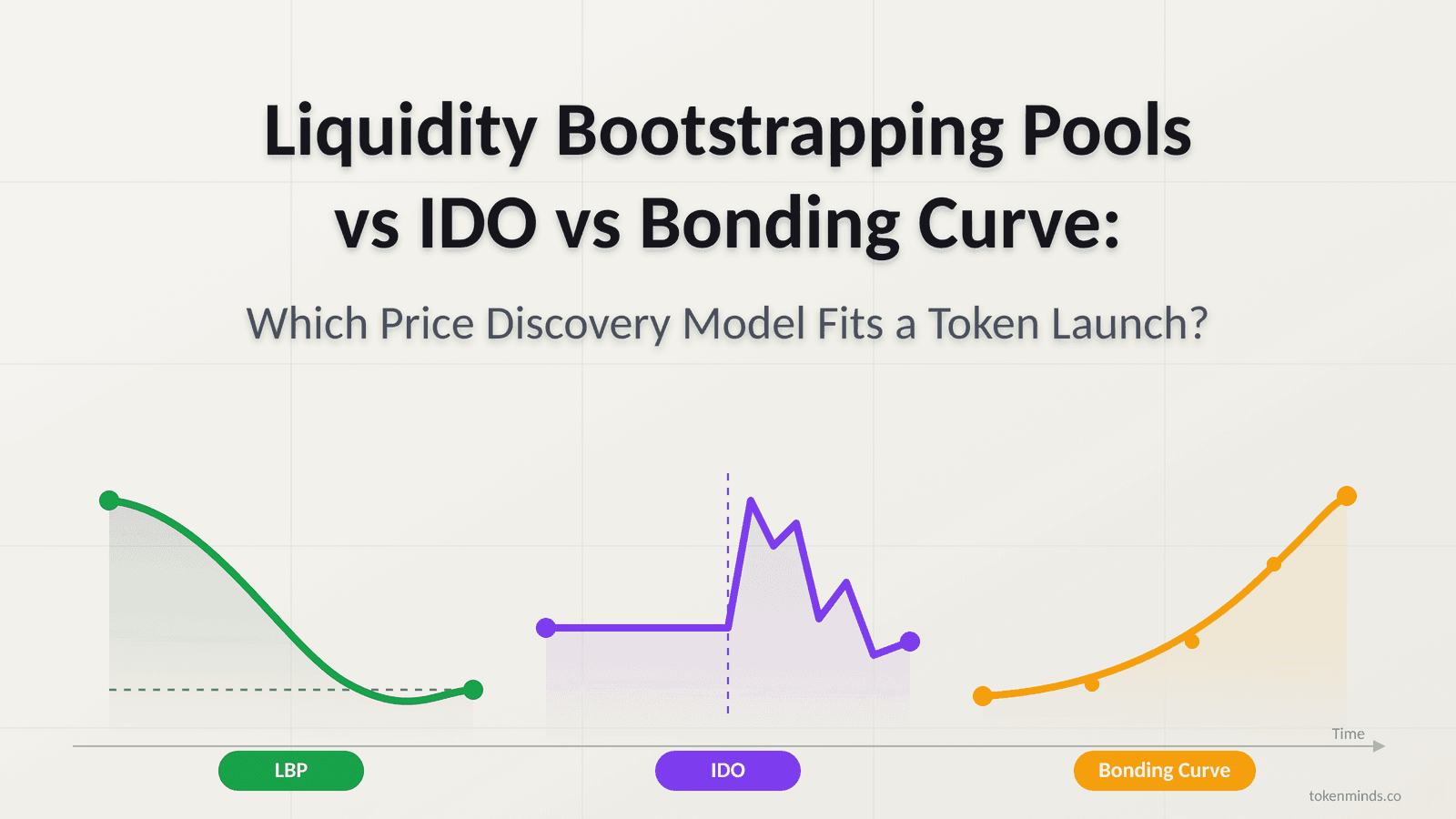
The mechanism decides when discovery happens. A fixed-price sale postpones it until the token lists on an exchange. A pool with shifting weights or a formula-based curve performs it inside the sale itself. The three flows below show the difference.

  • LBP:
    Pool opens at a high price → Weights shift and the price falls → Buyers step in when it looks fair → Price settles during the sale

  • IDO:
    Team sets a fixed price → Buyers purchase allocations → Token lists on a DEX → Market discovers the real price

  • Bonding curve:
    First buyer pays the lowest price → Each purchase raises the price → Price is discovered with every trade

Where discovery happens shapes buyer behavior. In the IDO flow, buyers expect a jump at listing, so they race to enter first, and bots race faster. In the LBP flow, entering first costs more, so the race disappears. In the bonding curve flow, entering first pays best, so the race is the product.

The mechanism also shapes the treasury. A fixed-price sale needs the team to seed a liquidity pool after the sale closes. An LBP lets a team start with a small stablecoin reserve. A bonding curve builds its reserve from buyer deposits.

Five criteria capture these effects: fairness, buyer UX, liquidity and treasury needs, compliance, and post-launch market design. The sections below apply them to each model, starting with the LBP.

How Liquidity Bootstrapping Pools Work for a Token Sale

A liquidity bootstrapping pool is a two-token pool whose weights change over time. Balancer's documentation describes LBPs as pools that "can dynamically change token weighting (e.g 1/99 to 99/1 for TokenA/TokenB)" using weighted math with time-dependent weights. The pool owner sets the start and end weights and times. The owner can also pause swaps and is the only address that can join the pool.

A weight is the share of the pool's value each token holds. When most of the weight sits on the project token, that token is expensive. As the weight shifts toward the paired asset, the price falls step by step until it reaches a level the market accepts.

Three features explain why this design matters for a token sale.

tm74_lbp_mindmap_1.png

How the Price Falls Over Time

The pool opens at a deliberately high price, set above what the team believes is fair. That opening price works as the ceiling for the sale. Buyers gain nothing from rushing in, so most wait until the price drops to a level they consider fair. Buying holds the price up, waiting lets it fall, and the two meet near market value.

In practice, an LBP behaves like a Dutch auction. The price starts high and falls until buyers accept it. Fjord Foundry, the main platform for running LBPs, markets them as fair launch auctions for this reason, and Balancer's documentation lists it as a primary LBP use case.

Why Bots and Whales Lose Their Edge

A sniper who buys at the open pays the ceiling, not a discount. The high start removes the reason to grab a large share of the pool in the first minutes. That pushes tokens toward patient buyers instead of a few large wallets, which spreads distribution across more holders.

How Much Capital the Team Needs

Far less than a standard pool. Balancer's own example opens an LBP with 10% or 20% of the pool in a stablecoin like DAI, while other platforms may require 50%.

LBP Parameter Reference

The ranges below are practitioner guidance drawn from documented launches, not Balancer requirements. Each project should test them against its own raise target and treasury.

Parameter

Recommended range

Starting weight ratio

90/10 to 95/5, project token to paired asset

Ending weight ratio

50/50 to 60/40, aligned with the permanent DEX pool to avoid arbitrage

Duration

48 to 72 hours, so buyers across time zones can take part

Token allocation

15% to 25% of total supply. Below 15% limits price discovery, and above 25% risks oversupply

Paired asset

ETH or USDC on mainnet, or the native pair of the chain where the sale runs

The trade-off with any LBP is UX. A falling price confuses buyers used to fixed sales, so teams that want a simpler buyer journey often look at the IDO instead.

How IDO Pricing Works for a Token Sale

In an IDO, the team fixes the price before the sale, so the market has no say until the token lists. An initial DEX offering sells tokens at that fixed price through a decentralized launchpad. As covered in the ICO vs IDO vs IEO comparison, the launchpad handles wallet access, allocations, and often a whitelist or tier system. Buyers know the price before the sale opens, and the sale usually closes fast.

That timing produces two features that sit close to the opposite of the LBP:

Fixed Price and Launchpad Allocations

The team and the launchpad agree on a fixed price and a raise target before the sale. Buyers receive capped allocations, and tiers reward holders of the launchpad's token. The raise is predictable, which is the model's main appeal. The cost is that the team hears nothing from the market about the price until listing day.

Bot and Sell-Pressure Risk at Listing

The gap between the sale price and the listing price is the prize. Bots target the first blocks after listing, and buyers who entered at a discount sell into the first candles. That is the reverse of the LBP, where entering first costs the most.

That sell pressure lands on the liquidity pool the team must seed after the sale. Teams typically launch on Uniswap or another major DEX. If the pool is too shallow to absorb early selling, the listing gap turns into a sharp drop. Some projects pair the sale with an initial liquidity offering to fund the pool at launch. The bonding curve avoids the listing gap altogether by pricing during the sale.

How Bonding Curve Pricing Works for a Token Sale

A bonding curve prices the token by formula, tied to the supply already sold, so every purchase raises what the next buyer pays. As explained in the guide to bonding curve token launches, the first buyer pays the lowest price, and each later buyer pays more. Sellers return tokens to the contract and receive the paired asset from its reserve.

Bancor introduced the model, and launchpads like Pump.fun made it the default for community-led tokens. On these platforms the curve runs until a funding target fills. The token then graduates, which means liquidity migrates to a standard DEX pool and open-market trading begins. That graduation moment decides the post-launch market.

Balancer's documentation draws the contrast directly. It describes bonding curves as an older sale model and notes that in an LBP, unlike a bonding curve, users "are disincentivized to buy early." That difference produces two features that push in the opposite direction from the LBP.

Price Rises With Supply

Linear curves raise the price by a fixed step per token. Exponential curves accelerate as supply grows. Both keep the token tradable from the first purchase, with no separate sale and listing phases. Price discovery never stops, because every trade moves the curve.

Early-Buyer Advantage and Dump Risk

The rising curve rewards speed. Bots gain from entering first, and urgency builds among later buyers who see the price climbing. Early holders can then sell into that demand and drain the reserve, which leaves late buyers holding the drop.

Bonding curves suit continuous, experimental tokens more than a planned raise. With all three models in view, the comparison below sets them side by side.

LBP vs IDO vs Bonding Curve: Side-by-Side Comparison

The table applies the five criteria to each model, with two additions. Price discovery gets its own row because it is the subject of the article, and bot exposure is broken out of fairness because the two do not always move together. The compliance row describes where control sits, not legal advice.

Criterion

LBP

IDO

Bonding curve

Price discovery

During the sale, price falls to fair value

After the sale, at DEX listing

Continuous, every trade moves the price

Fairness and distribution

Wide, no reward for buying first

Depends on whitelist and tier rules

Favors the earliest buyers

Bot and whale exposure

Low, snipers pay the ceiling

High at listing

High at curve start

Buyer UX

Complex, a falling price needs explaining

Simple, fixed price and known allocation

Simple, instant buy and sell

Liquidity and treasury need

Low, 10% to 20% stablecoin to open

Team seeds the DEX pool after the sale

Reserve builds from buyer deposits

Compliance and control

Owner sets weights, pauses swaps, gates joins

Launchpad sets access rules

Permissionless, hardest to gate

Post-launch market

Opens near market value

Listing gap sets the tone

Curve graduation decides the market

No model wins every row, which is why the next section matches each one to a launch scenario.

Which Price Discovery Model Fits Which Token Launch Scenario

The right model matches the team's threat model and treasury, not the trend of the month. Three scenarios cover most launches.

When an LBP Fits

An LBP fits a launch where wide distribution matters more than a fixed raise.

  • The team wants a broad holder base, not a few large wallets.

  • Bot and whale pressure is expected at launch.

  • Stablecoin reserves are limited, so a 10% to 20% pool is all the treasury can fund.

  • The team can explain a falling price to buyers before the sale opens.

Not a fit when the project must raise an exact amount on a tight timeline, since open-ended price discovery is hard to plan around.

When an IDO Fits

An IDO fits a launch that needs a fast, predictable raise with a partner behind it.

  • The team wants a fixed price and a known raise target.

  • A launchpad partner brings its community and handles access rules.

  • A listing-day marketing plan is ready.

  • Liquidity is in place to absorb early selling after listing.

Not a fit when the team cannot seed a deep enough pool, since the first session will be volatile.

When a Bonding Curve Fits

A bonding curve fits a token meant to trade from the first minute with no fixed raise target.

  • The token should be tradable immediately, with no sale and listing split.

  • There is no raise target to hit.

  • The launch is community-led or experimental, and urgency is part of the design.

  • The team accepts that early buyers gain most.

Not a fit when the project needs broad, even distribution, since the curve rewards whoever arrives first.

On the question of which model is safest, none is safest in isolation. The safest model is the one whose weaknesses the team has planned for. An LBP is safest against bots. An IDO is safest for buyer clarity. A bonding curve is safest for liquidity continuity.

What Real Launches Show About Each Model

The differences between the models show up in documented launches, not only in theory. Three cases with public figures make the pattern clear.

HydraDX via LBP: Capital Efficiency on Record

Balancer's primer on fair launches records that HydraDX raised 22.9M DAI with only 1.2M DAI deposited at the start. The pool moved from 92.5/7.5 xHDX/DAI to 17.5/82.5 over the sale. Balancer estimates a 50/50 pool would have needed 14.8M DAI to reach the same result, and the sale set a record for LBP volume at the time.

Perpetual Protocol via LBP: Price Found During the Sale

Perpetual Protocol ran the first Balancer LBP in September 2020. The team's own write-up of the sale reports 1,355 participants over about three days, with the pool shifting from 90/10 to 30/70 PERP/USDC. The price ranged from 1.058 to 2.304 USDC and closed at 2.076, against an average of 1.635 USDC. Balancer's follow-up article puts total volume at $21.86M, and ICO Drops records the raise at $12.26M for 7.5M PERP. Volume is not the raise, since tokens changed hands more than once inside the pool.

Pump.fun Bonding Curves: Continuous Pricing, Rare Graduation

Solana Compass reported in June 2026 that fewer than 2% of Pump.fun tokens have ever graduated from the bonding curve to a DEX. Adam Tehc's Pump.Fun dashboard on Dune puts the cumulative rate near 1.4% across more than 11.9 million launches. The weekly rate moves sharply with platform incentives, but the cumulative picture holds. The curve keeps every token tradable from the first trade, and few build enough demand to leave it.

Fixed-price launches lack a single showcase case. The Memento Research data covering 2025 launches shows the pattern in aggregate. As of late December 2025, most tokens priced before listing traded below that price soon after, which is the listing gap at work.

Seven Checks Before Launching an LBP, IDO, or Bonding Curve

Choosing the model is half the work. The other half is a short list of checks that turn the choice into a safe launch.

  • Decide on the model using all five criteria, not fundraising speed alone.

  • Configure the sale parameters. For an LBP, that means start and end weights, duration, and an opening price high enough to act as the ceiling.

  • Fund the paired asset side and confirm the treasury can hold it through the sale.

  • Plan the post-sale market before the first trade, including liquidity, staking, and market-making incentives.

  • Explain to buyers in plain language how the price will move during the sale.

  • Review compliance for the chosen model and every jurisdiction the sale reaches.

  • Monitor the sale live, with one person holding authority to pause swaps where the model allows it.

A team that clears all seven has covered the decisions that separate a planned launch from a lucky one.

Get a Launch Mechanism Comparison Session With TokenMinds

The launch mechanism decides where a token's first price lands. The sections above show that the right choice comes from matching the model to liquidity, compliance, and distribution goals.

TokenMinds has run token sales end to end since 2016, from tokenomics and launch-mechanism design to launchpad coordination, PR and KOL campaigns, and post-launch tracking. Its launch mechanism comparison session models the LBP, IDO, or bonding curve decision for a specific project in one pass, so the team walks in with goals and out with a recommended mechanism and a plan to run it.

Book a launch mechanism comparison session with TokenMinds.

FAQs

Should a project use an LBP, IDO, or bonding curve?
It depends on the goal. An LBP fits wide distribution with limited treasury capital. An IDO fits a fast, fixed-price raise with launchpad support. A bonding curve fits a token meant to trade continuously from launch.

How do liquidity bootstrapping pools work for token launches?
An LBP is a pool whose token weights shift over time. It opens at a deliberately high price and lowers it progressively until buyers judge it fair, which Balancer notes discourages whales and bots from buying the pool early.

Which price discovery model is safest for a new token?
None is safest in every case. An LBP is safest against bots and whales, an IDO is safest for buyer clarity, and a bonding curve is safest for continuous liquidity. The safest choice is the one whose weaknesses the team has planned for.

What happens when a bonding curve token graduates?
Graduation is the point where a bonding curve sale ends and open-market trading begins. On platforms like Pump.fun, the curve runs until a funding target fills. Liquidity then migrates to a standard DEX pool, and the price is set by that pool rather than the curve. Fewer than 2% of Pump.fun tokens have reached that point.

TL;DR: The launch mechanism decides how a token sale finds its first price, who buys first, and how much capital the treasury must lock up. A liquidity bootstrapping pool starts high and lets the price fall toward fair value, which discourages bots and whales. An IDO sells at a fixed price through a launchpad and trades fairness for speed and reach. A bonding curve prices each token by supply sold and rewards early buyers. No model is safest by default, so the right choice depends on fairness, buyer UX, liquidity, compliance, and the market the team wants after launch.

The First Price Decides More Than the Raise

Most founders treat the token sale format as a fundraising question. How much to raise, on which platform, at what price. The format also answers a harder question. It decides how the market discovers the token's price in its first hours.

That first price matters more than most launch plans admit. Delphi Digital's State of Token Markets report, covering more than 540 tokens launched since 2020, found the average token spends about 70% of its life below launch price. Memento Research's review of 118 token launches in 2025 found 84.7% trading below their token generation event (TGE) valuation, with a median fully diluted valuation (FDV) drop of 71.1%. Starting valuation decided much of that outcome. Launches with an FDV between $25M and $200M did best, with 40% still positive, while all 28 launches above $1B FDV were down, at a median of roughly 81%. A launch that opens at the wrong price rarely recovers.

That is why the choice between a liquidity bootstrapping pool (LBP), an initial DEX offering (IDO) on a decentralized exchange, and a bonding curve deserves the same care as tokenomics. Each model discovers price differently, so each produces a different opening. This article explains how the three work and compares them on the criteria operators care about. It then offers a framework for choosing. Teams still shaping the wider raise can start with this token sale guide for Web3 firms before picking a mechanism.

Why the Launch Mechanism Is a Price Discovery Decision

A launch mechanism is the set of rules a token sale uses to sell tokens. It defines who can buy, at what price, and in what order. Price discovery is the process by which the market settles on what a token is worth. Every launch goes through it, either during the sale or right after.

The mechanism decides when discovery happens. A fixed-price sale postpones it until the token lists on an exchange. A pool with shifting weights or a formula-based curve performs it inside the sale itself. The three flows below show the difference.

  • LBP:
    Pool opens at a high price → Weights shift and the price falls → Buyers step in when it looks fair → Price settles during the sale

  • IDO:
    Team sets a fixed price → Buyers purchase allocations → Token lists on a DEX → Market discovers the real price

  • Bonding curve:
    First buyer pays the lowest price → Each purchase raises the price → Price is discovered with every trade

Where discovery happens shapes buyer behavior. In the IDO flow, buyers expect a jump at listing, so they race to enter first, and bots race faster. In the LBP flow, entering first costs more, so the race disappears. In the bonding curve flow, entering first pays best, so the race is the product.

The mechanism also shapes the treasury. A fixed-price sale needs the team to seed a liquidity pool after the sale closes. An LBP lets a team start with a small stablecoin reserve. A bonding curve builds its reserve from buyer deposits.

Five criteria capture these effects: fairness, buyer UX, liquidity and treasury needs, compliance, and post-launch market design. The sections below apply them to each model, starting with the LBP.

How Liquidity Bootstrapping Pools Work for a Token Sale

A liquidity bootstrapping pool is a two-token pool whose weights change over time. Balancer's documentation describes LBPs as pools that "can dynamically change token weighting (e.g 1/99 to 99/1 for TokenA/TokenB)" using weighted math with time-dependent weights. The pool owner sets the start and end weights and times. The owner can also pause swaps and is the only address that can join the pool.

A weight is the share of the pool's value each token holds. When most of the weight sits on the project token, that token is expensive. As the weight shifts toward the paired asset, the price falls step by step until it reaches a level the market accepts.

Three features explain why this design matters for a token sale.

tm74_lbp_mindmap_1.png

How the Price Falls Over Time

The pool opens at a deliberately high price, set above what the team believes is fair. That opening price works as the ceiling for the sale. Buyers gain nothing from rushing in, so most wait until the price drops to a level they consider fair. Buying holds the price up, waiting lets it fall, and the two meet near market value.

In practice, an LBP behaves like a Dutch auction. The price starts high and falls until buyers accept it. Fjord Foundry, the main platform for running LBPs, markets them as fair launch auctions for this reason, and Balancer's documentation lists it as a primary LBP use case.

Why Bots and Whales Lose Their Edge

A sniper who buys at the open pays the ceiling, not a discount. The high start removes the reason to grab a large share of the pool in the first minutes. That pushes tokens toward patient buyers instead of a few large wallets, which spreads distribution across more holders.

How Much Capital the Team Needs

Far less than a standard pool. Balancer's own example opens an LBP with 10% or 20% of the pool in a stablecoin like DAI, while other platforms may require 50%.

LBP Parameter Reference

The ranges below are practitioner guidance drawn from documented launches, not Balancer requirements. Each project should test them against its own raise target and treasury.

Parameter

Recommended range

Starting weight ratio

90/10 to 95/5, project token to paired asset

Ending weight ratio

50/50 to 60/40, aligned with the permanent DEX pool to avoid arbitrage

Duration

48 to 72 hours, so buyers across time zones can take part

Token allocation

15% to 25% of total supply. Below 15% limits price discovery, and above 25% risks oversupply

Paired asset

ETH or USDC on mainnet, or the native pair of the chain where the sale runs

The trade-off with any LBP is UX. A falling price confuses buyers used to fixed sales, so teams that want a simpler buyer journey often look at the IDO instead.

How IDO Pricing Works for a Token Sale

In an IDO, the team fixes the price before the sale, so the market has no say until the token lists. An initial DEX offering sells tokens at that fixed price through a decentralized launchpad. As covered in the ICO vs IDO vs IEO comparison, the launchpad handles wallet access, allocations, and often a whitelist or tier system. Buyers know the price before the sale opens, and the sale usually closes fast.

That timing produces two features that sit close to the opposite of the LBP:

Fixed Price and Launchpad Allocations

The team and the launchpad agree on a fixed price and a raise target before the sale. Buyers receive capped allocations, and tiers reward holders of the launchpad's token. The raise is predictable, which is the model's main appeal. The cost is that the team hears nothing from the market about the price until listing day.

Bot and Sell-Pressure Risk at Listing

The gap between the sale price and the listing price is the prize. Bots target the first blocks after listing, and buyers who entered at a discount sell into the first candles. That is the reverse of the LBP, where entering first costs the most.

That sell pressure lands on the liquidity pool the team must seed after the sale. Teams typically launch on Uniswap or another major DEX. If the pool is too shallow to absorb early selling, the listing gap turns into a sharp drop. Some projects pair the sale with an initial liquidity offering to fund the pool at launch. The bonding curve avoids the listing gap altogether by pricing during the sale.

How Bonding Curve Pricing Works for a Token Sale

A bonding curve prices the token by formula, tied to the supply already sold, so every purchase raises what the next buyer pays. As explained in the guide to bonding curve token launches, the first buyer pays the lowest price, and each later buyer pays more. Sellers return tokens to the contract and receive the paired asset from its reserve.

Bancor introduced the model, and launchpads like Pump.fun made it the default for community-led tokens. On these platforms the curve runs until a funding target fills. The token then graduates, which means liquidity migrates to a standard DEX pool and open-market trading begins. That graduation moment decides the post-launch market.

Balancer's documentation draws the contrast directly. It describes bonding curves as an older sale model and notes that in an LBP, unlike a bonding curve, users "are disincentivized to buy early." That difference produces two features that push in the opposite direction from the LBP.

Price Rises With Supply

Linear curves raise the price by a fixed step per token. Exponential curves accelerate as supply grows. Both keep the token tradable from the first purchase, with no separate sale and listing phases. Price discovery never stops, because every trade moves the curve.

Early-Buyer Advantage and Dump Risk

The rising curve rewards speed. Bots gain from entering first, and urgency builds among later buyers who see the price climbing. Early holders can then sell into that demand and drain the reserve, which leaves late buyers holding the drop.

Bonding curves suit continuous, experimental tokens more than a planned raise. With all three models in view, the comparison below sets them side by side.

LBP vs IDO vs Bonding Curve: Side-by-Side Comparison

The table applies the five criteria to each model, with two additions. Price discovery gets its own row because it is the subject of the article, and bot exposure is broken out of fairness because the two do not always move together. The compliance row describes where control sits, not legal advice.

Criterion

LBP

IDO

Bonding curve

Price discovery

During the sale, price falls to fair value

After the sale, at DEX listing

Continuous, every trade moves the price

Fairness and distribution

Wide, no reward for buying first

Depends on whitelist and tier rules

Favors the earliest buyers

Bot and whale exposure

Low, snipers pay the ceiling

High at listing

High at curve start

Buyer UX

Complex, a falling price needs explaining

Simple, fixed price and known allocation

Simple, instant buy and sell

Liquidity and treasury need

Low, 10% to 20% stablecoin to open

Team seeds the DEX pool after the sale

Reserve builds from buyer deposits

Compliance and control

Owner sets weights, pauses swaps, gates joins

Launchpad sets access rules

Permissionless, hardest to gate

Post-launch market

Opens near market value

Listing gap sets the tone

Curve graduation decides the market

No model wins every row, which is why the next section matches each one to a launch scenario.

Which Price Discovery Model Fits Which Token Launch Scenario

The right model matches the team's threat model and treasury, not the trend of the month. Three scenarios cover most launches.

When an LBP Fits

An LBP fits a launch where wide distribution matters more than a fixed raise.

  • The team wants a broad holder base, not a few large wallets.

  • Bot and whale pressure is expected at launch.

  • Stablecoin reserves are limited, so a 10% to 20% pool is all the treasury can fund.

  • The team can explain a falling price to buyers before the sale opens.

Not a fit when the project must raise an exact amount on a tight timeline, since open-ended price discovery is hard to plan around.

When an IDO Fits

An IDO fits a launch that needs a fast, predictable raise with a partner behind it.

  • The team wants a fixed price and a known raise target.

  • A launchpad partner brings its community and handles access rules.

  • A listing-day marketing plan is ready.

  • Liquidity is in place to absorb early selling after listing.

Not a fit when the team cannot seed a deep enough pool, since the first session will be volatile.

When a Bonding Curve Fits

A bonding curve fits a token meant to trade from the first minute with no fixed raise target.

  • The token should be tradable immediately, with no sale and listing split.

  • There is no raise target to hit.

  • The launch is community-led or experimental, and urgency is part of the design.

  • The team accepts that early buyers gain most.

Not a fit when the project needs broad, even distribution, since the curve rewards whoever arrives first.

On the question of which model is safest, none is safest in isolation. The safest model is the one whose weaknesses the team has planned for. An LBP is safest against bots. An IDO is safest for buyer clarity. A bonding curve is safest for liquidity continuity.

What Real Launches Show About Each Model

The differences between the models show up in documented launches, not only in theory. Three cases with public figures make the pattern clear.

HydraDX via LBP: Capital Efficiency on Record

Balancer's primer on fair launches records that HydraDX raised 22.9M DAI with only 1.2M DAI deposited at the start. The pool moved from 92.5/7.5 xHDX/DAI to 17.5/82.5 over the sale. Balancer estimates a 50/50 pool would have needed 14.8M DAI to reach the same result, and the sale set a record for LBP volume at the time.

Perpetual Protocol via LBP: Price Found During the Sale

Perpetual Protocol ran the first Balancer LBP in September 2020. The team's own write-up of the sale reports 1,355 participants over about three days, with the pool shifting from 90/10 to 30/70 PERP/USDC. The price ranged from 1.058 to 2.304 USDC and closed at 2.076, against an average of 1.635 USDC. Balancer's follow-up article puts total volume at $21.86M, and ICO Drops records the raise at $12.26M for 7.5M PERP. Volume is not the raise, since tokens changed hands more than once inside the pool.

Pump.fun Bonding Curves: Continuous Pricing, Rare Graduation

Solana Compass reported in June 2026 that fewer than 2% of Pump.fun tokens have ever graduated from the bonding curve to a DEX. Adam Tehc's Pump.Fun dashboard on Dune puts the cumulative rate near 1.4% across more than 11.9 million launches. The weekly rate moves sharply with platform incentives, but the cumulative picture holds. The curve keeps every token tradable from the first trade, and few build enough demand to leave it.

Fixed-price launches lack a single showcase case. The Memento Research data covering 2025 launches shows the pattern in aggregate. As of late December 2025, most tokens priced before listing traded below that price soon after, which is the listing gap at work.

Seven Checks Before Launching an LBP, IDO, or Bonding Curve

Choosing the model is half the work. The other half is a short list of checks that turn the choice into a safe launch.

  • Decide on the model using all five criteria, not fundraising speed alone.

  • Configure the sale parameters. For an LBP, that means start and end weights, duration, and an opening price high enough to act as the ceiling.

  • Fund the paired asset side and confirm the treasury can hold it through the sale.

  • Plan the post-sale market before the first trade, including liquidity, staking, and market-making incentives.

  • Explain to buyers in plain language how the price will move during the sale.

  • Review compliance for the chosen model and every jurisdiction the sale reaches.

  • Monitor the sale live, with one person holding authority to pause swaps where the model allows it.

A team that clears all seven has covered the decisions that separate a planned launch from a lucky one.

Get a Launch Mechanism Comparison Session With TokenMinds

The launch mechanism decides where a token's first price lands. The sections above show that the right choice comes from matching the model to liquidity, compliance, and distribution goals.

TokenMinds has run token sales end to end since 2016, from tokenomics and launch-mechanism design to launchpad coordination, PR and KOL campaigns, and post-launch tracking. Its launch mechanism comparison session models the LBP, IDO, or bonding curve decision for a specific project in one pass, so the team walks in with goals and out with a recommended mechanism and a plan to run it.

Book a launch mechanism comparison session with TokenMinds.

FAQs

Should a project use an LBP, IDO, or bonding curve?
It depends on the goal. An LBP fits wide distribution with limited treasury capital. An IDO fits a fast, fixed-price raise with launchpad support. A bonding curve fits a token meant to trade continuously from launch.

How do liquidity bootstrapping pools work for token launches?
An LBP is a pool whose token weights shift over time. It opens at a deliberately high price and lowers it progressively until buyers judge it fair, which Balancer notes discourages whales and bots from buying the pool early.

Which price discovery model is safest for a new token?
None is safest in every case. An LBP is safest against bots and whales, an IDO is safest for buyer clarity, and a bonding curve is safest for continuous liquidity. The safest choice is the one whose weaknesses the team has planned for.

What happens when a bonding curve token graduates?
Graduation is the point where a bonding curve sale ends and open-market trading begins. On platforms like Pump.fun, the curve runs until a funding target fills. Liquidity then migrates to a standard DEX pool, and the price is set by that pool rather than the curve. Fewer than 2% of Pump.fun tokens have reached that point.

GET SUCCESS IN WEB3

  • Trusted Web3 partner since 2017

  • Full-stack Web3 development team

  • Performance-driven Web3 marketing

Get A Free Consultation

Get A Free Consultation

MEET US AT

RECENT TRAININGS

Follow us

get web3 business updates

Email invalid

  • Access global liquidity for your RWA project with TMX Tokenize’s Canton Network integration

DISCOVER NOW

  • Access global liquidity for your RWA project with TMX Tokenize’s Canton Network integration

    JOIN NOW

DISCOVER

  • Access global liquidity for your RWA project with TMX Tokenize’s Canton Network integration